
Canada’s Average Hourly Wages YoY: December 2025 Release and Macroeconomic Implications
Table of Contents
- Big-Picture Snapshot
- Foundational Indicators
- Chart Dynamics
- Forward Outlook
- Closing Thoughts
- Key Markets Likely to React to Average Hourly Wages YoY
The latest Average Hourly Wages Year-over-Year (YoY) figure for Canada, released on December 5, 2025, stands at 4.00%. This matches the previous month’s reading and the consensus estimate, according to the Sigmanomics database. The wage growth rate has shown resilience throughout 2025, recovering from a mid-year trough of 3.20% in July. This steady pace reflects ongoing labor market tightness despite global economic headwinds.
Drivers this month
- Shelter and healthcare sectors contributed positively, adding approximately 0.15 percentage points.
- Manufacturing wages remained flat, exerting neutral influence.
- Service sector wage growth accelerated slightly, supporting the overall figure.
Policy pulse
The 4.00% wage growth remains above the Bank of Canada’s inflation target midpoint of 2%, signaling persistent wage pressures. This may complicate the central bank’s efforts to anchor inflation expectations, potentially influencing future rate decisions.
Market lens
Immediate reaction: The Canadian dollar (CADUSD) appreciated modestly by 0.10% within the first hour post-release, while 2-year government bond yields edged up 3 basis points, reflecting cautious optimism about sustained economic momentum.
Wage growth is a critical macroeconomic indicator, closely linked to consumer spending, inflation, and monetary policy. The 4.00% YoY increase in average hourly wages in Canada compares favorably to the 12-month average of approximately 3.70% recorded since early 2025. This suggests a moderate acceleration in wage pressures.
Historical comparisons
- February 2025: 3.70% YoY wage growth
- July 2025: 3.20% YoY, the lowest point this year
- December 2024: 3.90% YoY, indicating a slight upward trend into 2025
Monetary policy & financial conditions
The Bank of Canada has maintained a cautious stance, with the policy rate steady at 4.25% since October 2025. Wage growth at 4.00% suggests underlying inflationary pressures, which could prompt further tightening if sustained. Financial conditions remain moderately tight, with credit spreads stable but cautious lending behavior noted.
Fiscal policy & government budget
Federal fiscal policy remains moderately expansionary, with targeted infrastructure spending and social program enhancements supporting labor demand. However, budget deficits are narrowing, limiting additional stimulus. Wage growth supports tax revenue but may increase government wage bill pressures.

This chart confirms a clear upward trend in wage growth since mid-2025, reversing a summer slowdown. The stabilization at 4.00% suggests persistent labor market tightness, which could sustain inflationary pressures and influence monetary policy decisions in early 2026.
Market lens
Immediate reaction: The Canadian dollar (CADUSD) strengthened by 0.10%, while 2-year bond yields rose by 3 basis points, indicating market recognition of sustained wage-driven inflation risks.
Looking ahead, wage growth in Canada faces several potential trajectories shaped by domestic and external factors. The baseline scenario assumes wage growth remains near 4.00%, supporting steady consumer spending and moderate inflation. This scenario carries a 55% probability.
Bullish scenario (25% probability)
- Wage growth accelerates to 4.50% or higher, driven by tight labor markets and strong fiscal stimulus.
- Consumer spending surges, boosting GDP growth above 3% annually.
- Monetary policy remains accommodative but vigilant.
Bearish scenario (20% probability)
- Wage growth slows below 3.50% due to global recession risks and weaker demand.
- Inflation pressures ease, allowing the Bank of Canada to pause or cut rates.
- Financial markets experience increased volatility and risk aversion.
Risks and uncertainties
External shocks such as geopolitical tensions or commodity price swings could disrupt wage dynamics. Additionally, structural trends like automation and demographic shifts may moderate long-run wage growth despite short-term volatility.
Canada’s Average Hourly Wages YoY at 4.00% in December 2025 reflects a labor market that remains tight but balanced. The data suggest ongoing wage pressures that could sustain inflation near the Bank of Canada’s target ceiling. Policymakers face a delicate task balancing growth and inflation risks amid evolving global conditions.
Financial markets have so far digested the data without major disruption, signaling confidence in the central bank’s forward guidance. However, wage growth remains a key variable to watch in 2026 as it will influence consumer behavior, inflation trends, and monetary policy decisions.
Key Markets Likely to React to Average Hourly Wages YoY
The Average Hourly Wages YoY figure is a vital gauge of labor market health and inflationary pressures. Markets sensitive to Canadian economic data typically include currency pairs, government bonds, and select equities. Wage growth influences consumer spending, corporate earnings, and central bank policy expectations, driving price action across these assets.
- CADUSD: The Canadian dollar often strengthens with rising wages due to expectations of tighter monetary policy.
- TXN: Technology stocks like TXN can be sensitive to wage-driven inflation impacting input costs.
- SHOP: Retail and e-commerce firms respond to consumer spending shifts linked to wage trends.
- BTCUSD: Bitcoin may react to inflation expectations influenced by wage growth.
- USDCAD: The inverse of CADUSD, this pair moves inversely with Canadian economic strength.
FAQ
- What is the significance of Average Hourly Wages YoY in Canada?
- Average Hourly Wages YoY measures wage inflation, impacting consumer spending, inflation, and monetary policy decisions.
- How does wage growth affect the Bank of Canada’s policy?
- Higher wage growth can signal inflation risks, prompting the Bank of Canada to consider tightening monetary policy.
- What are the risks to wage growth in Canada?
- Risks include global economic slowdowns, geopolitical shocks, and structural changes like automation reducing labor demand.
Takeaway: Canada’s steady 4.00% wage growth signals persistent labor market strength, posing both opportunities and challenges for policymakers and markets in 2026.
This has been drafted with AI assistance and then thoroughly reviewed, refined, and approved by our human editorial team to ensure accuracy, and originality.
TXN – Technology sector sensitivity to wage inflation.
SHOP – Retail sector exposure to consumer wage-driven spending.
CADUSD – Direct currency impact from Canadian wage data.
USDCAD – Inverse currency pair reflecting Canadian economic strength.
BTCUSD – Crypto market reaction to inflation expectations.
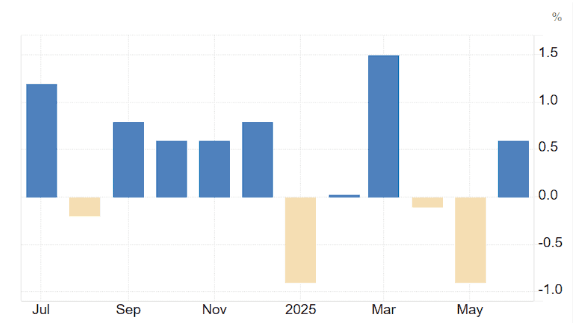






The December 2025 wage growth print of 4.00% YoY matches November’s figure and exceeds the 12-month average of 3.70%. This marks a reversal from the summer dip to 3.20% in July, indicating renewed wage momentum heading into year-end.
Monthly data show a steady climb since August’s 3.50%, with wage growth stabilizing at a level consistent with moderate inflationary pressures. The chart below illustrates this trend, highlighting the resilience of wage gains despite global uncertainties.