
December 2025 BoC Interest Rate Decision: Steady at 2.25%, Navigating a Complex Economic Landscape
Key Takeaways: The Bank of Canada (BoC) held its policy rate steady at 2.25% in December 2025, matching market expectations and maintaining the rate unchanged since October. This pause reflects a cautious stance amid moderating inflation, resilient labor markets, and evolving global risks. Core inflation edged down to 3.10% in November from 3.30% in October, while GDP growth slowed to 1.20% annualized. Financial conditions remain moderately tight but stable. The BoC’s decision balances upside inflation risks against external uncertainties, with a base-case scenario favoring a steady rate through Q1 2026.
Table of Contents
- Big-Picture Snapshot
- Foundational Indicators
- Chart Dynamics
- Forward Outlook
- Closing Thoughts
- Key Markets Likely to React to BoC Interest Rate Decision
In November 2025, the Bank of Canada maintained its overnight rate at 2.25%, unchanged from October’s level and well below the 3.75% peak recorded in October 2024. This marks the fourth consecutive hold, signaling a cautious approach amid mixed economic signals. The decision aligns with the BoC’s inflation target of 2%, as headline inflation eased modestly to 3.10% in November from 3.30% in October, reflecting cooling price pressures after a year of aggressive hikes.
Drivers this month
- Inflation moderation: Core CPI declined to 3.10% YoY in November from 3.30% in October.
- GDP growth slowed to 1.20% annualized in Q3 2025, down from 1.80% in Q2.
- Labor market remains tight with unemployment steady at 5.00%, near historic lows.
- Global uncertainties, including US-China trade tensions and energy price volatility.
Policy pulse
The BoC’s steady rate reflects a balancing act between persistent inflation above target and signs of economic slowing. The current 2.25% rate is below the estimated neutral rate of approximately 2.75%, suggesting some monetary accommodation remains. However, the central bank’s forward guidance emphasizes data dependency, with risks skewed toward inflation surprises or external shocks.
Market lens
Following the announcement, the Canadian dollar (CAD) showed mild appreciation against the US dollar, reflecting relief at the absence of a rate cut. Short-term bond yields held steady, while equity markets responded positively to the clarity on policy. Inflation breakevens in the 5-year horizon edged down slightly, signaling market confidence in the BoC’s inflation control.
November 2025’s core macroeconomic indicators reveal a nuanced picture. Consumer Price Index (CPI) inflation slowed to 3.10% YoY, down from 3.30% in October and well below the 3.80% average over the past 12 months. Energy prices contributed to this easing, with gasoline prices falling 4.50% MoM. Meanwhile, wage growth remained firm at 4.20% YoY, sustaining consumer spending power.
GDP growth for Q3 2025 was revised down to 1.20% annualized, a deceleration from 1.80% in Q2 and 2.00% in Q1. The slowdown reflects weaker business investment and softer exports amid global trade tensions. The unemployment rate held steady at 5.00%, consistent with a tight labor market that supports wage pressures.
Fiscal policy & government budget
Federal fiscal policy remains expansionary, with the 2025 budget projecting a CAD 45 billion deficit, slightly higher than the CAD 42 billion deficit in 2024. Increased infrastructure spending and social programs aim to support growth but add to medium-term debt concerns. The fiscal stance complements monetary policy by providing some economic stimulus.
External shocks & geopolitical risks
Global risks persist, including ongoing US-China trade frictions and energy market volatility driven by geopolitical tensions in the Middle East. These factors weigh on Canadian exports and commodity prices, adding uncertainty to the BoC’s outlook.
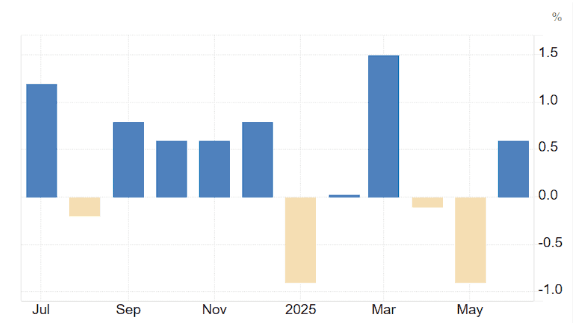
This chart reveals a clear trend of easing inflation paired with slowing growth, underscoring the BoC’s rationale for pausing rate hikes. The data suggest inflation pressures are abating but remain above target, while economic momentum is waning. This dynamic supports a cautious, data-driven policy stance in the near term.
Market lens
Immediate reaction: CAD/USD strengthened 0.30% post-announcement, reflecting market approval of the steady rate. The 2-year Government of Canada bond yield held near 2.30%, while inflation breakevens for 5 years declined by 5 basis points, signaling tempered inflation expectations.
Looking ahead, the BoC faces a complex environment. Inflation is trending downward but remains above the 2% target. Economic growth is slowing, and external risks persist. The central bank’s forward guidance suggests a cautious approach, with three plausible scenarios:
Bullish scenario (20% probability)
- Inflation falls rapidly below 2%, allowing the BoC to cut rates by 25-50 bps in H1 2026.
- Stronger global growth boosts exports and business investment.
- Fiscal stimulus supports domestic demand.
Base scenario (60% probability)
- Inflation gradually declines toward 2.50% by mid-2026.
- Growth remains modest but positive, around 1.00-1.50% annualized.
- Monetary policy remains on hold through Q1 2026, with potential hikes deferred.
Bearish scenario (20% probability)
- Inflation remains sticky above 3%, forcing further rate hikes.
- Global shocks trigger recessionary pressures, weakening growth below 1%.
- Financial conditions tighten sharply, impacting credit availability.
The BoC’s decision to hold rates steady reflects the base scenario’s dominance. However, close monitoring of inflation data and external developments will be critical in the coming months.
The December 2025 BoC Interest Rate Decision underscores a cautious monetary policy stance amid a shifting economic backdrop. Inflation is easing but remains above target, while growth slows and external risks persist. The central bank’s steady rate at 2.25% balances these factors, signaling readiness to adjust as data evolve. Fiscal policy remains supportive, but geopolitical uncertainties and financial market volatility warrant vigilance.
Investors and policymakers should watch upcoming inflation prints, wage trends, and global developments closely. The BoC’s path will likely remain data-dependent, with a bias toward patience unless inflation surprises to the upside. This environment favors a moderate Canadian dollar and stable bond yields in the near term.
Key Markets Likely to React to BoC Interest Rate Decision
The BoC’s interest rate decision typically influences several key markets. The Canadian dollar (CADUSD) often moves in response to rate changes and forward guidance, reflecting shifts in yield differentials and investor sentiment. Government bond yields, especially the 2-year Canada yield (CA2Y), track monetary policy expectations closely. Equity markets, represented by the S&P/TSX Composite Index (TSX), react to growth and inflation outlooks. Additionally, the USDCAD pair inversely correlates with BoC policy shifts, while Bitcoin (BTCUSD) can reflect broader risk sentiment influenced by interest rate environments.
- CADUSD – Directly impacted by BoC rate decisions and inflation outlook.
- TSX – Canadian equities sensitive to economic growth and monetary policy.
- USDCAD – Inverse relationship with BoC rate hikes and CAD strength.
- CA2Y – Short-term bond yields track policy rate expectations.
- BTCUSD – Reflects risk appetite influenced by interest rate trends.
Since 2020, CADUSD has shown a strong positive correlation with BoC rate changes, appreciating during tightening cycles and weakening during cuts. The recent steady rate at 2.25% supports a stable CAD outlook, barring external shocks. Monitoring this pair alongside CA2Y yields offers a clear gauge of market expectations for Canadian monetary policy.
FAQs
- What is the current BoC interest rate as of December 2025?
- The BoC interest rate is steady at 2.25%, unchanged since October 2025.
- How does the BoC decision affect inflation expectations?
- The steady rate and forward guidance have slightly lowered inflation breakeven rates, signaling market confidence in inflation moderation.
- What are the main risks to the BoC’s outlook?
- Key risks include persistent inflation above target, global trade tensions, and geopolitical shocks impacting commodity prices and growth.
Takeaway: The BoC’s December 2025 hold at 2.25% reflects a balanced approach amid easing inflation and slowing growth. The central bank remains data-dependent, with a cautious eye on external risks and domestic inflation dynamics.
Updated 12/10/25
This has been drafted with AI assistance and then thoroughly reviewed, refined, and approved by our human editorial team to ensure accuracy, and originality.





November’s inflation rate of 3.10% YoY compares favorably to October’s 3.30% and is below the 12-month average of 3.80%. This downward trend is supported by easing energy costs and moderated shelter inflation, which contributed 0.18 percentage points less to headline CPI than in October. Conversely, wage growth and services inflation remain sticky, limiting faster disinflation.
GDP growth’s deceleration to 1.20% annualized in Q3 2025 contrasts with 1.80% in Q2 and the 12-month average of 1.70%, highlighting a softening economy. The slowdown is evident in business investment, which contracted 0.50% MoM in November, and exports, which declined 1.20% MoM amid weaker global demand.