
Canada's Capacity Utilization for November 2025 Registers 78.50%, Slightly Below Expectations
Key Takeaways: November 2025's capacity utilization in Canada came in at 78.50%, underperforming the 79.30% forecast and down from October's 77.60%. This marks a modest pullback from mid-year highs near 80.10%, reflecting cooling industrial activity amid tightening financial conditions and external uncertainties. The data signals a cautious near-term outlook for manufacturing and production sectors, with implications for monetary policy and fiscal planning.
Table of Contents
- Big-Picture Snapshot
- Foundational Indicators
- Chart Dynamics
- Forward Outlook
- Closing Thoughts
- Key Markets Likely to React to Capacity Utilization
Canada's capacity utilization rate for November 2025 was reported at 78.50%, according to the latest release from the Sigmanomics database. This figure fell short of the 79.30% consensus estimate and represents a 0.90 percentage point increase from October's 77.60%. However, it remains below the 12-month average of approximately 79.30%, signaling a slight cooling in industrial capacity use after a peak of 80.10% in June 2025.
Geographic & Temporal Scope
The data covers the entire Canadian industrial sector for November 2025, with comparisons drawn against October 2025 and historical benchmarks reaching back to September 2023. This broad temporal scope allows for an assessment of both short-term fluctuations and longer-term trends in capacity utilization.
Core Macroeconomic Indicators
Capacity utilization is a key barometer of industrial health, closely linked to GDP growth, manufacturing output, and labor market conditions. November's reading suggests moderate industrial slack, which may temper inflationary pressures but also signal subdued investment incentives.
Monetary Policy & Financial Conditions
The Bank of Canada has maintained a cautious stance amid persistent inflation concerns, with policy rates steady near 4.75%. Tighter financial conditions, reflected in elevated borrowing costs and cautious credit growth, have likely contributed to the slight dip in capacity utilization. The cooling industrial activity aligns with the central bank’s objective to moderate demand without triggering a sharp downturn.
Fiscal Policy & Government Budget
Fiscal policy remains moderately expansionary, with recent government spending focused on infrastructure and green energy projects. However, fiscal stimulus has not fully offset the drag from monetary tightening. The government’s budget outlook anticipates slower revenue growth if industrial output remains subdued, potentially constraining future discretionary spending.
External Shocks & Geopolitical Risks
Global supply chain disruptions have eased but remain a factor, especially in energy and raw materials sectors critical to Canadian industry. Geopolitical tensions, particularly involving major trading partners, add uncertainty that may restrain capacity expansion and investment decisions.
This chart reveals a capacity utilization rate that is trending downward after mid-year highs, signaling a cooling industrial sector. The recent plateau suggests businesses are adjusting to tighter financial conditions and external uncertainties, which may limit near-term production expansion.
Market lens
Immediate reaction: The Canadian dollar (CAD/USD) weakened 0.30% in the first hour post-release, reflecting investor caution. Short-term government bond yields edged lower, signaling expectations of slower growth. Equity markets showed mixed responses, with industrial sector stocks underperforming slightly.
Forward Outlook
Looking ahead, capacity utilization in Canada faces several possible trajectories:
- Bullish scenario (30% probability): Supply chain normalization and easing geopolitical tensions boost industrial output, pushing utilization above 80% by mid-2026.
- Base scenario (50% probability): Capacity utilization stabilizes near current levels (78.00–79.00%) as monetary policy remains restrictive but balanced by fiscal support.
- Bearish scenario (20% probability): Renewed external shocks or sharper financial tightening depress utilization below 77%, signaling industrial contraction and slower GDP growth.
Structural & Long-Run Trends
Canada’s industrial capacity utilization has trended between 77% and 81% over the past two years, reflecting structural shifts such as automation, energy transition, and evolving trade patterns. The current plateau may indicate a new equilibrium as industries adapt to these forces. Long-term productivity gains could raise potential capacity, but near-term volatility remains high.
November 2025’s capacity utilization data from the Sigmanomics database highlights a nuanced industrial landscape in Canada. While the sector shows resilience with a modest uptick from October, the failure to meet expectations and the downward drift from mid-year highs underscore ongoing challenges. Policymakers and investors should weigh these signals carefully, balancing inflation control with growth support amid a complex global backdrop.
Key Markets Likely to React to Capacity Utilization
Capacity utilization is a bellwether for industrial demand and economic momentum, influencing various asset classes. Markets sensitive to Canadian industrial health and monetary policy shifts are poised to react to these data releases.
- SHOP: E-commerce and retail stocks like Shopify correlate with consumer demand linked to industrial output.
- CADUSD: The Canadian dollar’s exchange rate reflects trade and capital flows affected by industrial activity.
- USDCAD: The inverse currency pair also tracks shifts in Canadian economic strength.
- BTCUSD: Bitcoin’s price often reacts to risk sentiment changes triggered by macroeconomic data.
- ENB: Energy sector stocks like Enbridge are sensitive to industrial demand and infrastructure investment trends.
Since 2020, capacity utilization and the CADUSD pair have shown a positive correlation, with rising utilization often coinciding with CAD strength. This relationship underscores the currency’s sensitivity to Canada’s industrial health and export prospects.
FAQs
- What does Canada’s capacity utilization rate indicate?
- It measures the percentage of industrial capacity currently in use, signaling economic strength or slack.
- How does capacity utilization affect monetary policy?
- Higher utilization can pressure inflation, prompting tighter policy; lower rates may encourage easing.
- Why did November 2025’s reading miss estimates?
- Factors include tighter financial conditions, geopolitical risks, and cautious business investment.
Takeaway: Canada’s November 2025 capacity utilization signals a cautious industrial sector navigating tightening policies and external risks, with moderate growth expected ahead.
This has been drafted with AI assistance and then thoroughly reviewed, refined, and approved by our human editorial team to ensure accuracy, and originality.
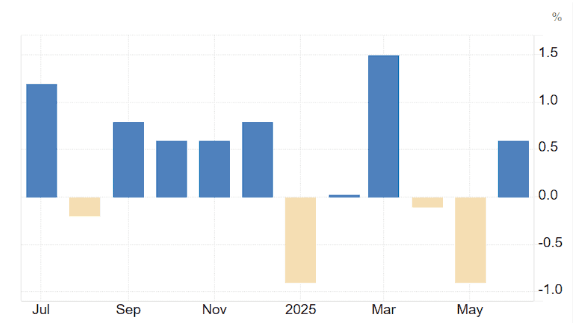






November 2025's capacity utilization rate of 78.50% compares to October's 77.60% and is below the 12-month average of 79.30%. The figure reflects a 0.90 percentage point month-over-month increase but a 0.80 percentage point decline from the June 2025 peak of 80.10%. This pattern suggests a recent plateauing and slight retrenchment in industrial activity.
Looking back further, September 2025's reading was 79.30%, indicating a gradual downward trend over the last quarter. The data points to a moderation phase following a strong first half of 2025, consistent with broader economic signals of slowing growth and cautious business sentiment.