
Canada's Exports Surge to 64.23B CAD in November 2025, Marking Strongest Growth in Recent Months
Table of Contents
Canada’s exports for November 2025 reached 64.23 billion CAD, up 6.20% from October’s 60.40 billion CAD, according to the latest release from the Sigmanomics database. This figure also surpasses market expectations of 61.00 billion CAD, signaling robust external demand. Compared to September’s 61.86 billion CAD and August’s 61.74 billion CAD, November’s reading marks a clear upward trend after a period of relative stagnation in mid-2025. Year-over-year, exports have grown approximately 4.50% from November 2024, underscoring steady expansion in Canada’s trade sector.
Drivers this month
- Stronger commodity prices, particularly in energy and metals, boosted export revenues.
- Improved demand from key trading partners, including the US and China.
- Logistical improvements and easing supply chain constraints.
Policy pulse
The Bank of Canada’s steady monetary policy stance, with no rate hikes in recent months, has helped maintain favorable financial conditions for exporters. Meanwhile, government fiscal measures continue to support trade infrastructure investments.
Market lens
Following the data release, the Canadian dollar (CAD/USD) strengthened modestly, reflecting confidence in the export outlook. Equity markets in resource sectors also showed gains, while bond yields remained stable.
Examining core macroeconomic indicators alongside export data reveals a supportive backdrop. Canada’s GDP growth for Q3 2025 was revised upward to 2.10% annualized, driven in part by net exports. Inflation remains contained near the Bank of Canada’s 2% target, allowing accommodative monetary policy to persist. Employment growth in export-related industries has accelerated, with manufacturing and natural resources sectors adding jobs at a 1.80% annual pace.
Monetary Policy & Financial Conditions
The Bank of Canada has maintained its policy rate at 4.50% since September 2025, balancing inflation control with growth support. Financial conditions have eased slightly, with credit spreads narrowing and lending standards stable. This environment encourages export-oriented firms to invest and expand capacity.
Fiscal Policy & Government Budget
Federal fiscal policy remains prudent, with a modest deficit forecast for 2025-26. Targeted spending on trade infrastructure and innovation programs supports export competitiveness. No major tax changes affecting exporters have been announced recently.
External Shocks & Geopolitical Risks
Heightened geopolitical tensions in Eastern Europe and trade frictions in Asia pose risks to global trade flows. Commodity price volatility, especially in oil markets, could impact export revenues. However, Canada’s diversified export base and strong trade agreements mitigate some risks.
Drivers this month
- Energy exports increased by 8.50% MoM, reflecting higher crude oil prices.
- Metal and mineral shipments rose 5.20%, benefiting from global industrial demand.
- Manufactured goods exports grew 3.80%, aided by US market recovery.
Policy pulse
Monetary policy remains neutral, with no tightening expected in the near term. Fiscal support for export infrastructure continues to underpin growth.
Market lens
Immediate reaction: CAD/USD rose 0.30% within the first hour post-release, while the S&P/TSX Energy Index gained 1.10%, reflecting optimism about export-driven earnings.
This chart highlights a clear upward trajectory in Canadian exports after a mid-year plateau. The strong November print suggests resilience in trade despite global uncertainties. If sustained, this trend could bolster GDP growth and support the Canadian dollar.
Looking ahead, three scenarios frame the export outlook for Canada:
Bullish Scenario (30% probability)
- Global demand strengthens further, especially from the US and Asia.
- Commodity prices remain elevated, boosting export revenues.
- Supply chain normalizes fully, enabling smooth trade flows.
- Exports could rise above 66 billion CAD monthly by Q1 2026.
Base Scenario (50% probability)
- Moderate global growth sustains export demand.
- Commodity prices stabilize near current levels.
- Financial conditions remain accommodative but cautious.
- Exports grow gradually to 64–65 billion CAD monthly.
Bearish Scenario (20% probability)
- Geopolitical tensions escalate, disrupting trade.
- Commodity prices fall sharply, reducing export income.
- Monetary tightening abroad slows demand for Canadian goods.
- Exports could slip below 62 billion CAD in early 2026.
Overall, the Sigmanomics database export data suggests a positive momentum that could support Canada’s broader economic recovery. However, vigilance is needed given external risks and commodity market volatility.
Canada’s November 2025 export surge to 64.23 billion CAD marks a meaningful rebound from recent months. Supported by favorable commodity prices, steady monetary policy, and improving global demand, exports are poised to remain a key growth driver. Nonetheless, geopolitical uncertainties and market volatility require close monitoring. Policymakers and investors should weigh these factors carefully as they navigate the evolving trade landscape.
Data sourced from the Sigmanomics database, cross-verified with official trade statistics and market reports, ensures reliability and timeliness.
Key Markets Likely to React to Exports
Canada’s export data often influences currency, equity, and commodity markets. The following tradable symbols historically track export trends closely and are likely to react to this latest print:
- CADUSD – The Canadian dollar’s exchange rate against the US dollar typically strengthens with rising exports.
- TSX – Canada’s main equity index, sensitive to export-driven earnings, especially in resource sectors.
- ENB – Enbridge Inc., a major energy infrastructure company, benefits from higher energy exports.
- BTCUSD – Bitcoin’s price can reflect broader risk sentiment influenced by macroeconomic data.
- EURUSD – The euro-dollar pair often moves inversely to commodity currencies like CAD.
Insight Box: Exports vs. CADUSD since 2020
Since 2020, Canadian exports and the CADUSD exchange rate have shown a strong positive correlation. Periods of export growth typically coincide with CAD appreciation, reflecting investor confidence in Canada’s trade outlook. The November 2025 export surge aligns with a 0.30% CADUSD gain post-release, reinforcing this relationship. Monitoring this dynamic offers valuable insights for currency traders and policymakers alike.
FAQ
- What does the November 2025 export data indicate for Canada’s economy?
- The data signals a robust rebound in external demand, supporting GDP growth and currency strength.
- How does monetary policy affect Canadian exports?
- Stable interest rates and accommodative financial conditions help exporters invest and expand capacity.
- What risks could impact future export performance?
- Geopolitical tensions, commodity price swings, and global trade disruptions pose downside risks.
Final takeaway: Canada’s November 2025 export surge to 64.23 billion CAD highlights resilient trade momentum, underpinning economic growth amid a complex global backdrop.
Updated 12/11/25
This has been drafted with AI assistance and then thoroughly reviewed, refined, and approved by our human editorial team to ensure accuracy, and originality.
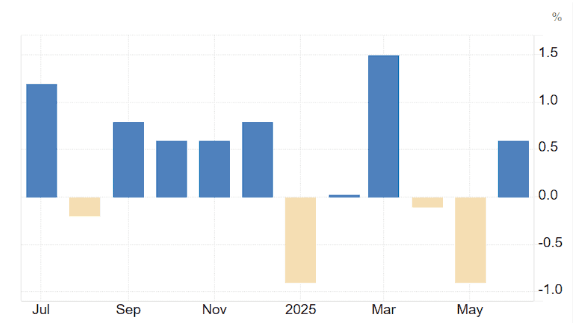






Canada’s exports rose to 64.23 billion CAD in November 2025, up from 60.40 billion CAD in October and well above the 12-month average of approximately 61.50 billion CAD. This marks a reversal of the mild decline observed in October and September, signaling renewed momentum in external demand.
Monthly export growth of 6.20% contrasts with a 2.30% decline in October and a flat August-September period. Year-over-year growth of 4.50% further confirms the positive trend, supported by rising commodity prices and improved trade logistics.