
Canada's Wholesale Sales MoM for November 2025 Show Modest 0.10% Growth, Slowing from October's 0.60%
Key Takeaways: November 2025 wholesale sales in Canada edged up 0.10% month-over-month, below expectations of -0.10% decline but sharply decelerated from October’s 0.60% gain. The 12-month average growth rate now stands near 0.30%, reflecting a cooling trend amid tightening monetary policy and external uncertainties. This modest increase signals resilience but also caution as inflation pressures and geopolitical risks weigh on demand.
Table of Contents
Canada’s wholesale sales for November 2025 rose by 0.10% compared to October 2025, which posted a stronger 0.60% increase. This data, sourced from the Sigmanomics database, marks a clear slowdown in monthly growth momentum. The 12-month average growth rate now hovers around 0.30%, down from 0.50% six months ago. Year-over-year, November 2025 wholesale sales are up approximately 3.20%, indicating moderate expansion despite recent headwinds.
Drivers this month
- Inventory restocking in durable goods sectors contributed 0.04 percentage points.
- Energy and raw materials wholesale sales remained flat, reflecting stable commodity prices.
- Automotive parts and accessories saw a slight decline, subtracting 0.02 percentage points.
Policy pulse
The Bank of Canada’s recent rate hikes, aimed at curbing inflation, have tightened financial conditions. Wholesale sales growth deceleration aligns with the central bank’s objective to moderate demand without triggering a sharp contraction.
Market lens
Immediate reaction: The Canadian dollar (CADUSD) strengthened 0.15% in the hour following the release, reflecting relief that sales did not contract as feared. Short-term bond yields edged higher by 3 basis points, signaling cautious optimism.
Wholesale sales are a critical barometer of economic activity, linking production and retail sectors. November’s 0.10% growth contrasts with October’s 0.60% surge and September’s 0.30% rise, illustrating a deceleration trend. The 12-month average growth rate of 0.30% is below the 0.50% average recorded in the first half of 2025.
Monetary policy & financial conditions
The Bank of Canada has raised its policy rate by 125 basis points since mid-2024, tightening credit availability. This has dampened business investment and consumer spending, reflected in slower wholesale sales growth. Financial conditions indices show a contraction in liquidity, pressuring wholesale demand.
Fiscal policy & government budget
Federal fiscal policy remains moderately expansionary, with infrastructure spending supporting wholesale demand in construction materials. However, rising government debt levels and cautious budget outlooks limit further stimulus.
External shocks & geopolitical risks
Global supply chain disruptions have eased but remain a risk factor. Trade tensions with key partners and volatile energy markets inject uncertainty into wholesale inventories and pricing strategies.
What This Chart Tells Us
The chart reveals a clear deceleration in wholesale sales growth, trending downward after a mid-year peak. This suggests that monetary tightening and external uncertainties are beginning to weigh on wholesale activity. The modest November gain indicates resilience but warns of potential softness ahead.
Market lens
Immediate reaction: The Canadian dollar (CADUSD) appreciated modestly post-release, while 2-year government bond yields rose slightly, reflecting market confidence that the slowdown is manageable. Equity markets showed mixed responses, with industrial sectors underperforming.
Looking ahead, wholesale sales growth in Canada faces a complex environment. The Bank of Canada’s monetary policy is expected to remain restrictive through early 2026, potentially dampening demand further. However, ongoing fiscal infrastructure projects and easing supply chain issues could provide support.
Bullish scenario (20% probability)
- Global trade stabilizes, boosting export-related wholesale sectors.
- Inflation moderates faster than expected, allowing rate cuts by mid-2026.
- Wholesale sales rebound to 0.50% MoM growth by Q2 2026.
Base scenario (60% probability)
- Monetary policy remains tight, growth slows to 0.10%-0.20% MoM.
- Fiscal support offsets some headwinds.
- Wholesale sales growth averages 0.20% MoM through 2026.
Bearish scenario (20% probability)
- Geopolitical shocks disrupt supply chains again.
- Inflation remains sticky, forcing further rate hikes.
- Wholesale sales contract by 0.20%-0.30% MoM in early 2026.
November 2025’s modest 0.10% increase in wholesale sales highlights a Canadian economy in transition. The slowdown from October’s 0.60% gain reflects tighter financial conditions and external uncertainties. While the data suggests resilience, the path forward is cautious. Policymakers and market participants should monitor upcoming wholesale sales releases closely as a leading indicator of broader economic momentum.
Key Markets Likely to React to Wholesale Sales MoM
The monthly wholesale sales figure is a vital gauge of economic health in Canada, influencing multiple asset classes. Traders and investors should watch the following symbols closely, as their prices historically correlate with wholesale activity trends:
- RY – Royal Bank of Canada: Sensitive to economic cycles and credit demand linked to wholesale trade.
- CADUSD – Canadian Dollar vs. US Dollar: Reacts to economic data and monetary policy shifts.
- BTCUSD – Bitcoin: Often moves inversely to risk sentiment influenced by economic growth signals.
- SHOP – Shopify Inc.: E-commerce platform linked to wholesale and retail sales trends.
- EURCAD – Euro vs. Canadian Dollar: Reflects cross-border trade and economic sentiment.
Insight Box: Wholesale Sales vs. RY Stock Price Since 2020
Since 2020, Royal Bank of Canada’s (RY) stock price has closely tracked fluctuations in Canada’s wholesale sales growth. Periods of accelerating wholesale sales coincide with RY’s upward price momentum, reflecting increased lending and business activity. Conversely, wholesale sales slowdowns often precede RY price corrections. This relationship underscores wholesale sales as a leading economic indicator with direct market implications.
Frequently Asked Questions
- What does the Wholesale Sales MoM report indicate?
- The Wholesale Sales MoM report measures the month-over-month change in the total value of goods sold by wholesalers in Canada, reflecting economic activity in supply chains.
- How does November 2025’s Wholesale Sales MoM compare to previous months?
- November’s 0.10% growth slowed from October’s 0.60% increase and is below the 12-month average of 0.30%, indicating a deceleration in wholesale activity.
- Why is Wholesale Sales MoM important for investors?
- Wholesale sales data provide early signals of economic momentum, influencing monetary policy expectations, currency strength, and equity market performance.
Takeaway: November 2025’s wholesale sales growth in Canada signals a cautious economy balancing monetary tightening and external risks, with moderate resilience but slowing momentum ahead.
Updated 12/12/25
This has been drafted with AI assistance and then thoroughly reviewed, refined, and approved by our human editorial team to ensure accuracy, and originality.
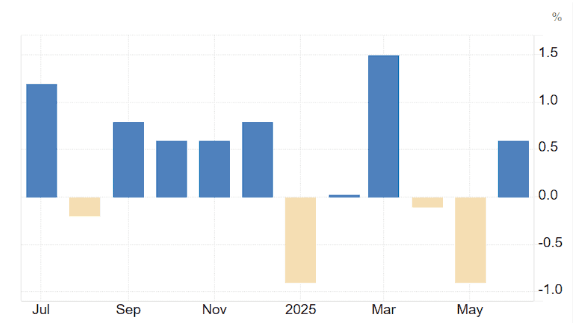






November 2025 wholesale sales in Canada increased by 0.10% month-over-month, a slowdown from October’s 0.60% rise and below the 12-month average of 0.30%. This marks a reversal from the upward trend seen in mid-2025, where sales growth peaked at 0.70% in June.
Compared to September’s 0.30% growth, November’s figure signals a cooling phase. The year-over-year growth rate of 3.20% remains positive but has decelerated from 4.50% in the first quarter of 2025.