
Hungary's Construction Output YoY for November 2025: Moderating Growth Amid Mixed Signals
Key Takeaways: Hungary’s Construction Output YoY for November 2025 rose 9.70%, down from October’s 17.60%, missing the 12.00% estimate. This slowdown follows a volatile year marked by sharp rebounds and contractions. Monetary tightening, fiscal recalibration, and external risks cloud near-term prospects despite structural demand. Market reaction was muted, reflecting cautious optimism amid uncertainty.
Table of Contents
Hungary’s construction sector posted a 9.70% year-over-year (YoY) growth in November 2025, according to the latest release from the Sigmanomics database. This figure represents a significant deceleration from October’s 17.60% surge and falls short of the 12.00% consensus forecast. The November reading compares to a 12-month average growth rate of approximately 1.90%, underscoring the sector’s recent volatility.
Drivers this month
- Public infrastructure projects slowed after a strong October push.
- Private residential construction remained resilient but showed signs of plateauing.
- Supply chain disruptions and rising input costs constrained expansion.
Policy pulse
The Hungarian National Bank’s (MNB) recent monetary tightening cycle, aimed at curbing inflation, has increased borrowing costs. This has dampened construction financing, particularly for private developers. Meanwhile, government fiscal policy is shifting toward budget consolidation, limiting new stimulus for infrastructure.
Market lens
Immediate reaction: The Hungarian forint (HUF) weakened slightly against the euro, while 2-year government bond yields edged higher, reflecting cautious investor sentiment. Construction-related equities showed muted responses.
Construction output is a critical barometer of economic health in Hungary, linking to GDP growth, employment, and investment trends. The sector’s YoY growth of 9.70% in November 2025 contrasts with a sharp contraction of -15.20% in October 2025 and a rebound from negative territory earlier in the year (e.g., -9.60% in March 2025).
Historical context
- March 2025: -9.60%
- June 2025: -0.50%
- September 2025: 4.90%
- October 2025: -15.20%
- November 2025: 9.70%
Macroeconomic backdrop
Hungary’s GDP growth slowed to 2.10% YoY in Q3 2025, reflecting weaker domestic demand and external headwinds. Inflation remains elevated at 7.30%, prompting the MNB to maintain a restrictive monetary stance. Unemployment held steady near 3.80%, supporting consumer spending but limiting labor supply for construction.
Fiscal policy & budget
Government spending on infrastructure projects has been scaled back in the 2025 budget, focusing on efficiency and EU fund absorption. This fiscal tightening contrasts with 2024’s expansionary stance, reducing a key growth driver for construction.
What This Chart Tells Us
Market lens
Immediate reaction: EUR/HUF rose 0.30% post-release, reflecting mild disappointment versus expectations. Hungarian 2-year bond yields increased by 5 basis points, signaling higher risk premiums. Construction sector equities, including BUX, showed limited volatility.
Bullish scenario (30% probability)
Improved EU fund disbursements and easing supply chain constraints could revive public infrastructure projects. Combined with stable inflation and a pause in monetary tightening, construction output could accelerate above 12% YoY in early 2026.
Base scenario (50% probability)
Moderate growth around 5-10% YoY persists, supported by steady private residential demand and selective public projects. Monetary policy remains restrictive but not prohibitive, while fiscal consolidation limits large-scale stimulus.
Bearish scenario (20% probability)
Rising interest rates and geopolitical tensions, including regional energy supply risks, could depress investment. Construction output might contract or stagnate, falling below 0% YoY by mid-2026.
Structural & long-run trends
Hungary’s construction sector faces long-term challenges from demographic shifts and labor shortages. However, EU green transition policies and digital infrastructure investments offer growth avenues. The sector’s ability to adapt to these trends will shape its trajectory beyond cyclical fluctuations.
November 2025’s construction output YoY growth of 9.70% highlights a sector in flux. While the rebound from October’s steep drop is encouraging, the miss against estimates and ongoing macroeconomic headwinds temper enthusiasm. Monetary tightening, fiscal restraint, and external uncertainties will continue to shape the sector’s near-term path.
Investors and policymakers should monitor inflation trends, EU fund flows, and geopolitical developments closely. The construction sector remains a bellwether for Hungary’s broader economic health, reflecting both cyclical dynamics and structural shifts.
Key Markets Likely to React to Construction Output YoY
The Hungarian construction output data influences several key markets, including equities, bonds, and currency pairs. Construction activity correlates with domestic economic momentum, credit conditions, and investor sentiment. Below are five tradable symbols with historical sensitivity to this indicator:
- BUX – Hungary’s benchmark stock index, sensitive to domestic economic growth and construction sector performance.
- EURHUF – The euro-to-Hungarian forint currency pair, reflecting capital flows and monetary policy expectations.
- USDHUF – US dollar to Hungarian forint, impacted by risk sentiment and external shocks.
- BTCUSD – Bitcoin’s price often reacts to macroeconomic uncertainty and liquidity conditions.
- MOL – Hungary’s leading energy company, linked to infrastructure investment and broader economic cycles.
Indicator vs. BUX Index Since 2020
Since 2020, Hungary’s construction output YoY growth has shown a positive correlation with the BUX index, particularly during periods of economic recovery and stimulus. Sharp contractions in construction output, such as in early 2025, coincided with BUX declines, while rebounds supported equity gains. This relationship underscores the construction sector’s role as a growth proxy and market sentiment driver.
FAQs
- What does Hungary’s Construction Output YoY indicate?
- The Construction Output YoY measures the annual percentage change in construction activity, reflecting economic health and investment trends in Hungary.
- How does monetary policy affect construction output?
- Higher interest rates increase borrowing costs, reducing construction financing and slowing sector growth.
- Why is construction output volatile in Hungary?
- Volatility arises from shifts in public spending, EU fund flows, supply chain issues, and macroeconomic cycles.
Takeaway: Hungary’s November 2025 construction output growth moderates but remains positive amid tightening monetary policy and fiscal restraint. The sector’s trajectory will hinge on external risks and policy responses in 2026.
This has been drafted with AI assistance and then thoroughly reviewed, refined, and approved by our human editorial team to ensure accuracy, and originality.
Updated 12/12/25
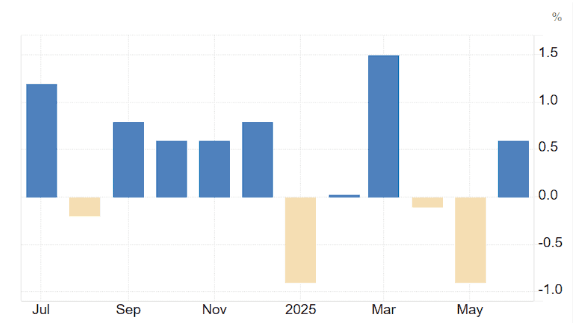






The November 2025 construction output YoY growth of 9.70% marks a notable slowdown from October’s 17.60%, yet remains well above the 12-month average of 1.90%. This volatility reflects a sector grappling with uneven demand and cost pressures.
October’s sharp decline of -15.20% was an outlier amid a generally positive trend since mid-2025, including steady gains in July (3.60%) and September (4.90%). The rebound in November suggests some resilience but also signals caution.