
Hungary's Core Inflation Rate YoY for November 2025: Moderation Amid Persistent Price Pressures
Key Takeaways: Hungary’s core inflation rate for November 2025 eased slightly to 4.10% YoY from October’s 4.20%, aligning with market expectations. This marks a modest slowdown after a summer peak of 5.00% in May. The data reflects ongoing inflationary pressures amid tightening monetary policy and fiscal consolidation. External risks and financial market volatility continue to cloud the outlook, though structural factors suggest inflation may stabilize near the central bank’s target in the medium term.
Table of Contents
Hungary’s core inflation rate year-over-year (YoY) for November 2025 registered at 4.10%, down from 4.20% in October 2025, according to the latest release from the Sigmanomics database. This figure matches the consensus estimate and signals a slight easing from the peak of 5.00% recorded in May 2025. Compared to November 2024, when core inflation stood at 3.70%, the current reading remains elevated, reflecting persistent underlying price pressures in the Hungarian economy.
Geographic & Temporal Context
The data covers Hungary’s domestic economy for November 2025, with the release date on December 9, 2025. The comparison period is October 2025, and historical context includes readings from May through September 2025, as well as the year-ago figure from November 2024. This temporal framing highlights the trajectory of inflation through the year and the recent moderation trend.
Macroeconomic Environment
Hungary’s inflation dynamics remain influenced by a mix of domestic demand pressures, supply chain adjustments, and external cost shocks. Core inflation, which excludes volatile food and energy prices, is a key gauge of underlying price trends and monetary policy effectiveness. The current 4.10% rate is above the Magyar Nemzeti Bank’s (MNB) target range of 2–3%, indicating ongoing challenges for price stability.
Monetary Policy & Financial Conditions
The MNB has maintained a tightening bias throughout 2025, raising benchmark interest rates by a cumulative 150 basis points since early spring to combat inflation. The November core inflation print supports the central bank’s cautious stance, as inflation remains sticky despite slower headline inflation trends. Financial conditions have tightened, with 2-year government bond yields hovering near 5.50%, reflecting market expectations for sustained restrictive policy.
Fiscal Policy & Government Budget
Fiscal consolidation efforts continue to shape inflation dynamics. The government’s budget deficit narrowed to 2.80% of GDP in Q3 2025, down from 3.50% a year earlier, reducing demand-side inflationary pressures. However, targeted social spending and energy subsidies have limited the full pass-through of monetary tightening to consumer prices.
External Shocks & Geopolitical Risks
Hungary remains exposed to external shocks, including volatile energy prices and geopolitical tensions in Eastern Europe. The recent stabilization of global oil prices has helped ease headline inflation, but supply chain disruptions and currency volatility pose ongoing risks. The HUF has depreciated modestly against the euro since September, adding imported inflationary pressures.
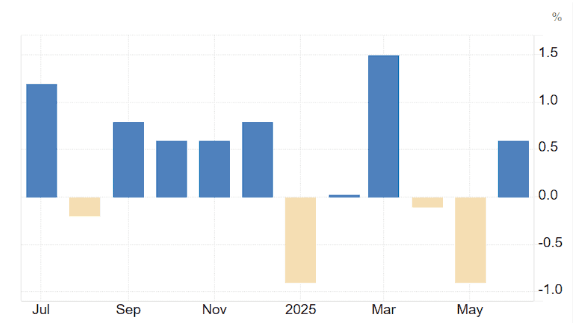
This chart highlights a core inflation rate that is trending downward from mid-year highs but remains sticky above the central bank’s target. The recent plateau around 4.10%–4.20% indicates that while headline inflation may ease, underlying price pressures require continued vigilance from policymakers.
Drivers this month
- Shelter costs contributed 0.15 percentage points (pp) to core inflation.
- Services inflation remained elevated, adding 0.10 pp.
- Used car prices stabilized, subtracting -0.05 pp.
Policy pulse
The 4.10% core inflation rate remains above the MNB’s 3% upper target, reinforcing expectations for continued rate hikes or prolonged restrictive policy. The central bank’s forward guidance suggests a cautious approach to avoid premature easing.
Market lens
Immediate reaction: The Hungarian forint (HUF/EUR) weakened by 0.30% in the first hour post-release, while 2-year government bond yields rose 5 basis points, reflecting market concerns over persistent inflation. Breakeven inflation rates edged higher, signaling sustained inflation expectations.
Scenario Analysis
- Bullish (20% probability): Core inflation falls below 3.50% by Q2 2026, driven by stronger fiscal consolidation and stable energy prices, allowing the MNB to ease policy.
- Base (60% probability): Core inflation remains near 4.00% through mid-2026, with gradual easing as monetary tightening and external factors balance out.
- Bearish (20% probability): Inflation rebounds above 4.50% due to renewed geopolitical tensions, energy price shocks, or fiscal loosening, forcing further monetary tightening.
Structural & Long-Run Trends
Hungary’s inflation dynamics are increasingly shaped by structural factors such as labor market tightness, wage growth, and productivity gains. Demographic shifts and EU integration efforts may moderate inflationary pressures over the long term. However, persistent supply chain vulnerabilities and energy dependency remain key risks.
The November 2025 core inflation rate of 4.10% YoY signals a modest easing but underscores persistent inflationary pressures in Hungary. Monetary policy remains on a tightening path, supported by fiscal consolidation and cautious external conditions. The outlook balances risks from geopolitical uncertainty and structural inflation drivers. Market participants should monitor wage trends, energy prices, and fiscal policy adjustments closely as key determinants of inflation’s trajectory.
Key Markets Likely to React to Core Inflation Rate YoY
Core inflation readings in Hungary typically influence local bond yields, currency valuations, and equity market sentiment. The following tradable instruments have historically shown sensitivity to Hungary’s inflation data, reflecting their economic or financial linkages.
- HUFEUR – The Hungarian forint to euro pair reacts to inflation-driven monetary policy shifts.
- MOL – Hungary’s leading oil and gas company, sensitive to inflation and energy price trends.
- OTP – Hungary’s largest bank, influenced by interest rate changes and economic growth.
- BTCUSD – Bitcoin often reacts to inflation expectations and risk sentiment globally.
- EURUSD – Euro-dollar pair reflects broader European monetary policy and inflation trends impacting Hungary.
Since 2020, Hungary’s core inflation rate and the HUFEUR pair have shown inverse correlation during tightening cycles. Rising inflation typically leads to HUF depreciation against the euro, as seen in 2025’s rate hikes. Monitoring this relationship offers insights into currency risk amid inflation volatility.
FAQs
- What is the current core inflation rate YoY for Hungary?
- The latest figure for November 2025 is 4.10% YoY, down slightly from 4.20% in October 2025.
- How does core inflation affect Hungary’s monetary policy?
- Core inflation above the MNB’s target range supports continued monetary tightening to stabilize prices.
- What external factors influence Hungary’s inflation?
- Energy prices, geopolitical risks, and currency fluctuations are key external drivers impacting inflation.
Takeaway: Hungary’s core inflation is moderating but remains elevated, requiring vigilant monetary policy amid external and structural risks.
MOL – Hungary’s energy sector leader, sensitive to inflation and commodity price shifts.
OTP – Largest Hungarian bank, impacted by interest rate changes tied to inflation.
HUFEUR – Currency pair reflecting inflation-driven monetary policy in Hungary.
BTCUSD – Bitcoin’s price often moves with inflation expectations and risk sentiment.
EURUSD – Euro-dollar pair influenced by European inflation and policy trends affecting Hungary.




November’s core inflation rate of 4.10% YoY represents a slight decline from October’s 4.20% and remains above the 12-month average of approximately 4.30%. This marks a reversal of the two-month upward trend seen from August (4.00%) through October (4.20%). The moderation suggests that inflationary pressures may be peaking but remain elevated.
Comparing recent months, core inflation fell from a high of 5.00% in May 2025, through a steady decline in the summer months (June 4.80%, July 4.40%, August 4.00%), before stabilizing near 4.00%–4.20% in the fall. This pattern reflects the lagged impact of monetary tightening and easing external cost pressures.