
Hungary's CPI for November 2025 Eases to 3.80%, Below Expectations
Key Takeaways: Hungary’s Consumer Price Index (CPI) for November 2025 slowed to 3.80% year-over-year, underperforming the 4.10% consensus and down from October’s 4.30%. This marks a notable easing in inflationary pressures after several months of steady elevated readings. Core inflation trends, monetary policy signals, and external risks will shape Hungary’s macro outlook heading into 2026.
Table of Contents
- Big-Picture Snapshot
- Foundational Indicators
- Chart Dynamics
- Forward Outlook
- Closing Thoughts
- Key Markets Likely to React to CPI
Hungary’s Consumer Price Index (CPI) for November 2025 registered a 3.80% year-over-year increase, easing from October’s 4.30% and missing the 4.10% consensus forecast, according to the latest release from the Sigmanomics database. This marks the first significant deceleration after five consecutive months holding at or above 4.30%. The month-over-month (MoM) comparison shows a decline from October’s inflation rate, signaling a potential softening in consumer price pressures.
Drivers this month
- Energy prices stabilized after summer volatility, contributing -0.15 percentage points (pp) to the CPI slowdown.
- Food inflation remained elevated but moderated slightly, adding 0.90 pp compared to 1.10 pp in October.
- Services inflation held steady at 3.50%, reflecting resilient domestic demand.
Policy pulse
The November CPI print remains above the Hungarian National Bank’s (MNB) 3% inflation target but shows a clear downward trend. This may reduce pressure on the central bank to tighten monetary policy aggressively in the near term, especially given recent signals of slowing credit growth and stable financial conditions.
Market lens
Immediate reaction: The Hungarian forint (HUF) strengthened modestly against the euro, with EUR/HUF down 0.30% in the first hour post-release. Short-term government bond yields declined by 5 basis points, reflecting eased inflation concerns.
Examining Hungary’s broader macroeconomic context, the November CPI figure fits into a pattern of gradual inflation moderation after a volatile first half of 2025. The 12-month average inflation rate now stands at approximately 4.10%, down from a peak of 5.60% in March 2025. This trend aligns with easing global commodity prices and a more stable domestic currency.
Monetary Policy & Financial Conditions
The MNB has maintained a cautious stance, keeping the base interest rate steady at 7.75% since September 2025. Inflation easing in November may delay further hikes, though the central bank remains vigilant against upside risks from wage growth and imported inflation. Credit growth slowed to 3.20% year-over-year in November, supporting a less hawkish outlook.
Fiscal Policy & Government Budget
Fiscal policy remains expansionary, with the government targeting a 3.50% deficit for 2025. Increased public spending on infrastructure and social programs supports domestic demand, which may sustain service sector inflation. However, prudent debt management and EU funding inflows help mitigate fiscal risks.
External Shocks & Geopolitical Risks
Hungary’s inflation trajectory is sensitive to external shocks, including energy price volatility and geopolitical tensions in Eastern Europe. Recent stabilization in natural gas prices and improved supply chain conditions have contributed to the November CPI easing. Nonetheless, ongoing uncertainties in the region warrant close monitoring.
What This Chart Tells Us
Market lens
Immediate reaction: The Hungarian forint (HUF) appreciated modestly, while 2-year government bond yields declined by 5 basis points. Breakeven inflation rates for the next 5 years also edged lower, reflecting market expectations of a slower inflation trajectory.
Looking ahead, Hungary’s inflation outlook balances between easing price pressures and persistent domestic demand. The following scenarios frame the near-term trajectory:
Bullish Scenario (30% probability)
- Continued moderation in energy and food prices.
- Stable currency and contained wage growth.
- Inflation falls below 3% by Q2 2026, allowing monetary easing.
Base Scenario (50% probability)
- Inflation stabilizes around 3.50%–4% through early 2026.
- Monetary policy remains on hold with gradual normalization.
- Fiscal stimulus supports moderate domestic demand.
Bearish Scenario (20% probability)
- External shocks push energy prices higher again.
- Wage pressures intensify, sustaining core inflation above 4%.
- MNB forced into further rate hikes, risking growth slowdown.
Overall, the November CPI print supports a cautiously optimistic outlook for Hungary’s inflation path, but risks remain from external volatility and domestic demand dynamics.
Hungary’s November 2025 CPI reading of 3.80% marks a meaningful step toward inflation stabilization after a turbulent year. The easing inflation rate, below consensus and prior month levels, reflects improving supply conditions and moderated energy prices. However, persistent core inflation and fiscal expansion suggest that disinflation will be gradual.
Monetary policy is likely to remain data-dependent, balancing inflation risks with growth concerns. External geopolitical and commodity price risks will continue to influence Hungary’s inflation trajectory. Market reactions indicate confidence in the inflation slowdown, but vigilance is warranted.
In sum, Hungary’s inflation dynamics in November provide a cautiously positive signal for 2026, with a path toward the MNB’s 3% target still achievable but contingent on stable external conditions and prudent policy management.
Key Markets Likely to React to CPI
Hungary’s CPI data typically influences currency, bond, and equity markets sensitive to inflation and monetary policy expectations. The following symbols historically track inflation developments closely:
- EURHUF – The euro/Hungarian forint pair reacts to inflation surprises, reflecting monetary policy expectations.
- BUX – Hungary’s benchmark stock index, sensitive to inflation-driven interest rate changes.
- USDHUF – The US dollar/HUF exchange rate, influenced by inflation differentials and risk sentiment.
- BTCUSD – Bitcoin’s price often reflects inflation hedging demand and risk appetite shifts.
- MSCIEM – Emerging markets equity index, impacted by inflation trends in Hungary and regionally.
FAQs
- What does Hungary’s November 2025 CPI indicate about inflation trends?
- The 3.80% CPI reading suggests a moderation in inflation pressures, signaling a potential easing trend after months of elevated rates.
- How might the MNB respond to the latest CPI data?
- The central bank may hold rates steady given the easing inflation, but remains ready to act if inflationary risks re-emerge.
- Why is the EURHUF exchange rate sensitive to Hungary’s CPI?
- Inflation influences monetary policy expectations, which in turn affect currency valuations, making EURHUF responsive to CPI surprises.
Takeaway: Hungary’s November CPI easing to 3.80% offers a cautiously optimistic outlook for inflation, balancing domestic demand and external risks as the economy approaches 2026.
This has been drafted with AI assistance and then thoroughly reviewed, refined, and approved by our human editorial team to ensure accuracy, and originality.
BUX – Hungary’s benchmark stock index, sensitive to inflation and monetary policy.
EURHUF – Euro/Hungarian forint FX pair, closely tracks inflation and policy shifts.
USDHUF – US dollar/HUF FX pair, influenced by inflation differentials.
BTCUSD – Bitcoin/USD, often reacts to inflation hedging demand.
MSCIEM – Emerging markets equity index, impacted by regional inflation trends.
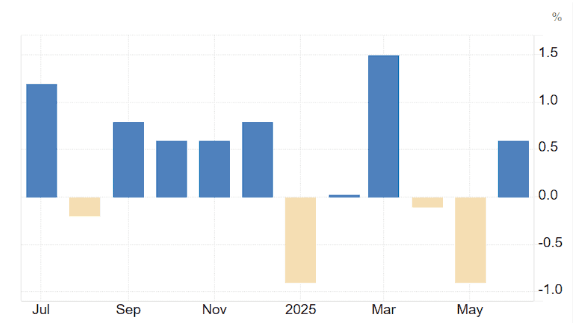




November 2025’s CPI reading of 3.80% contrasts with October’s 4.30% and the 12-month average of 4.10%, indicating a clear downward shift in inflation momentum. Month-over-month, inflation decelerated by 0.50 percentage points, the largest drop since June 2025.
Energy and food price contributions have notably softened compared to the summer months, while core inflation components such as services and housing costs remain sticky. This divergence highlights the mixed nature of inflation drivers in Hungary’s economy.