
Hungary's Industrial Production YoY Contracts Sharply in November 2025
Table of Contents
Hungary’s Industrial Production YoY for November 2025 contracted by -2.70%, according to the latest release from the Sigmanomics database. This figure contrasts sharply with October’s 1.30% growth and falls well below the consensus estimate of 1.50%. The reading signals a reversal from the modest recovery seen in early autumn and highlights growing pressures on Hungary’s industrial sector.
Drivers this month
- Manufacturing output weakened amid slowing demand in key export markets.
- Energy-intensive industries faced rising input costs due to elevated commodity prices.
- Supply chain disruptions persisted, particularly in automotive and electronics sectors.
Policy pulse
The contraction places additional strain on the Hungarian National Bank’s (MNB) monetary stance, which has been tightening to combat inflation. The weaker industrial output may prompt a reassessment of the pace of rate hikes or a more cautious forward guidance approach.
Market lens
Following the release, the Hungarian forint (HUF) depreciated modestly against the euro, reflecting concerns over growth prospects. Short-term government bond yields edged higher, signaling investor caution amid mixed macro signals.
Industrial production is a core macroeconomic indicator reflecting the health of Hungary’s manufacturing and mining sectors. The November 2025 contraction contrasts with a 12-month average growth rate of approximately 0.10%, underscoring a recent deterioration. Compared to August’s -4.90% and October’s -7.30% readings earlier in the year, November’s -2.70% shows some moderation but remains firmly negative.
Monetary policy & financial conditions
The MNB has raised policy rates multiple times in 2025 to tame inflation, which has hovered above the 3% target. Tighter financial conditions have increased borrowing costs for industrial firms, constraining investment and production capacity expansion. The negative industrial output growth aligns with these headwinds.
Fiscal policy & government budget
Hungary’s fiscal stance remains moderately expansionary, with targeted support for innovation and export-oriented industries. However, budget constraints limit large-scale stimulus, and the government faces pressure to balance fiscal prudence with growth support amid slowing industrial activity.
External shocks & geopolitical risks
Ongoing geopolitical tensions in Eastern Europe and disruptions in global supply chains have weighed on Hungary’s export-dependent industrial sector. Energy price volatility and trade uncertainties continue to pose risks to production stability.
This chart highlights Hungary’s industrial production as trending downward after a brief rebound in early autumn. The sector remains vulnerable to external demand shocks and tightening financial conditions. The November contraction suggests that the industrial sector may continue to face headwinds in the near term, requiring close monitoring.
Market lens
Immediate reaction: The Hungarian forint weakened by 0.30% against the euro within the first hour post-release, while 2-year government bond yields rose by 5 basis points, reflecting investor caution amid the disappointing print.
Looking ahead, Hungary’s industrial production faces a range of scenarios shaped by domestic and external factors. A bullish scenario (20% probability) assumes easing geopolitical tensions, stable energy prices, and accommodative fiscal policy, potentially returning industrial growth to 1-2% by mid-2026.
The base case (55% probability) projects continued modest contraction or stagnation around -1% to 0%, as monetary tightening and global uncertainties persist. A bearish scenario (25% probability) envisions deeper declines below -3%, driven by prolonged supply chain issues, rising input costs, and weaker export demand.
Structural & long-run trends
Hungary’s industrial sector is undergoing structural shifts toward higher value-added manufacturing and green technologies. However, legacy industries remain sensitive to cyclical shocks. Long-term growth depends on successful innovation adoption and integration into European supply chains.
Policy pulse
The MNB faces a delicate balancing act between controlling inflation and supporting growth. Fiscal authorities may need to enhance targeted support for industrial modernization to offset cyclical downturns.
November 2025’s industrial production YoY contraction to -2.70% signals renewed challenges for Hungary’s manufacturing sector. The data underscores the impact of tighter monetary policy, external shocks, and structural adjustments. Policymakers must weigh inflation control against growth support, while investors remain cautious amid volatility.
Monitoring upcoming releases and related indicators such as export orders and capacity utilization will be critical to assess whether this contraction is a temporary setback or the start of a more prolonged industrial slowdown.
Overall, Hungary’s industrial outlook remains clouded by uncertainty, but targeted policy measures and improving external conditions could help stabilize the sector in 2026.
Key Markets Likely to React to Industrial Production YoY
Hungary’s industrial production data significantly influences several financial markets, especially those linked to the country’s economic health and export dynamics. The following symbols historically track or react to industrial output changes, reflecting shifts in investor sentiment and economic fundamentals.
- OTP – Hungary’s largest bank, sensitive to economic growth and credit demand.
- EURHUF – The euro-Hungarian forint pair, reflecting currency risk tied to economic performance.
- USDHUF – Dollar-forint exchange rate, impacted by risk sentiment and monetary policy.
- BTCUSD – Bitcoin’s price, often a risk barometer reacting to macroeconomic shifts.
- MOL – Hungary’s leading energy company, linked to industrial energy demand and prices.
FAQs
- What does Hungary’s Industrial Production YoY indicate?
- It measures the annual percentage change in industrial output, signaling the health of manufacturing and mining sectors.
- How does the November 2025 reading affect Hungary’s economy?
- The -2.70% contraction suggests slowing industrial activity, which may dampen GDP growth and influence monetary policy decisions.
- What are the risks to Hungary’s industrial sector going forward?
- Risks include tightening financial conditions, geopolitical tensions, supply chain disruptions, and volatile energy prices.
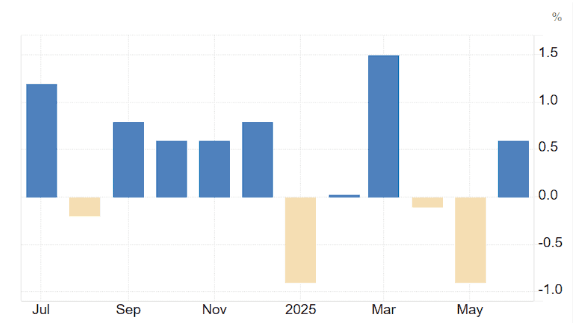




November 2025’s industrial production YoY at -2.70% contrasts with October’s 1.30% and the 12-month average near 0.10%. The data reveals a sharp reversal from the mild recovery seen in September (1.00%) and a significant improvement from the deep contraction in August (-4.90%). However, the negative trend from October to November signals renewed weakness.
Monthly comparisons show a volatile pattern: August and October saw steep declines (-4.90% and -7.30%), while September and November oscillated between slight growth and contraction. This volatility reflects external shocks and domestic policy adjustments impacting industrial output.