
Hungary's Inflation Rate MoM for November 2025 Shows Modest Uptick Amid Lingering Price Pressures
Key Takeaways: Hungary's inflation rate for November 2025 rose by 0.10% month-over-month, below the 0.40% consensus estimate but marking a rebound from October's flat reading. This modest increase signals persistent but contained inflationary pressures amid tightening monetary policy and cautious fiscal stance. External risks and financial market volatility remain key factors shaping Hungary's inflation trajectory heading into 2026.
Table of Contents
Hungary's inflation rate for November 2025 increased by 0.10% month-over-month (MoM), according to the latest release from the Sigmanomics database on December 9, 2025. This figure compares to a flat 0.00% MoM reading in October 2025 and falls short of the 0.40% consensus estimate. The 12-month average MoM inflation rate stands at approximately 0.15%, indicating that November's inflation was slightly below the recent trend.
Geographic & Temporal Scope
The data covers Hungary's consumer price inflation for November 2025, reflecting domestic price changes amid evolving macroeconomic conditions in Central Europe. This period captures the transition into winter months, typically associated with energy price volatility and seasonal demand shifts.
Core Macroeconomic Indicators
Hungary's subdued inflation increase follows a period of stabilization after mid-2025's elevated inflation rates, which peaked near 0.40% MoM in August. The consumer price index (CPI) components contributing to November's inflation included moderate rises in food prices (0.12%) and energy (0.08%), while transportation and housing costs remained broadly stable.
Monetary Policy & Financial Conditions
The Hungarian National Bank (MNB) has maintained a cautious tightening stance throughout 2025, with key interest rates held at 8.25% since September. The November inflation print, below expectations, may reduce immediate pressure for further hikes but keeps the door open for gradual tightening if inflationary pressures re-emerge. Financial conditions remain tight, with the Hungarian forint (HUF) exhibiting moderate volatility against the euro (EURHUF) and global risk sentiment influencing bond yields.
Fiscal Policy & Government Budget
Fiscal policy in Hungary remains prudent, with the government targeting a budget deficit near 3.50% of GDP for 2025. Public spending has been focused on social transfers and infrastructure, supporting domestic demand without overheating the economy. The fiscal stance complements monetary policy efforts to anchor inflation expectations.
External Shocks & Geopolitical Risks
Hungary faces ongoing external risks including energy price fluctuations linked to geopolitical tensions in Eastern Europe and global supply chain disruptions. These factors contribute to inflation uncertainty, particularly in energy and food sectors. Additionally, EU regulatory changes and trade dynamics continue to influence Hungary's inflation outlook.
Drivers this month
- Food prices contributed 0.12 percentage points, driven by seasonal supply constraints.
- Energy prices added 0.08 percentage points, reflecting winter heating demand.
- Transportation and housing costs were largely neutral, with minor declines offsetting other gains.
Policy pulse
The inflation reading remains above the MNB's 3% annual target when annualized, supporting the central bank's cautious stance. However, the below-forecast MoM increase may temper expectations for aggressive rate hikes in the near term.
Market lens
Immediate reaction: EURHUF dipped 0.15% post-release, reflecting mild relief. Short-term government bond yields fell by 5 basis points, signaling reduced inflation risk premium. Breakeven inflation rates edged lower, consistent with tempered inflation expectations.
This chart highlights a gradual easing of inflation pressures since summer 2025, with November's modest rise suggesting a plateau rather than acceleration. The trend points to a cautiously optimistic outlook but underscores the need for vigilance amid external uncertainties.
Forward Outlook
Looking ahead to December 2025 and early 2026, Hungary's inflation trajectory faces several scenarios:
- Bullish (20% probability): Inflation moderates further to near 0.05% MoM as energy prices stabilize and supply chains improve, allowing the MNB to pause tightening.
- Base (60% probability): Inflation remains around 0.10-0.15% MoM, reflecting persistent but manageable price pressures amid steady monetary and fiscal policies.
- Bearish (20% probability): Inflation accelerates above 0.30% MoM due to renewed energy shocks or geopolitical tensions, forcing more aggressive rate hikes and tighter financial conditions.
Key risks include volatility in global energy markets, EU regulatory shifts, and domestic wage pressures. The MNB's communication will be critical in anchoring inflation expectations and guiding market sentiment.
Closing Thoughts
Hungary's November 2025 inflation rate MoM of 0.10% signals a modest but meaningful uptick after a flat October. While below expectations, the figure confirms that inflation remains a central macroeconomic challenge. The interplay of monetary restraint, fiscal prudence, and external shocks will shape Hungary's inflation path in the near term. Market participants should monitor energy prices and geopolitical developments closely, as these remain key drivers of inflation volatility.
Key Markets Likely to React to Inflation Rate MoM
Hungary's inflation data typically influences several asset classes, including domestic currency pairs, government bonds, and regional equities. Movements in these markets reflect changing inflation expectations and monetary policy outlooks.
- EURHUF: The primary currency pair impacted by Hungarian inflation, sensitive to shifts in monetary policy and risk sentiment.
- BUX: Hungary's benchmark stock index, which reacts to inflation-driven changes in consumer demand and corporate earnings.
- OTP: Hungary's largest bank, sensitive to interest rate changes and credit conditions influenced by inflation.
- BTCUSD: Bitcoin often acts as an inflation hedge, with price movements reflecting broader inflation concerns.
- USDHUF: The USD-HUF pair also reacts to inflation data, especially in risk-off environments.
Since 2020, EURHUF has shown a strong correlation with Hungary's inflation trends, appreciating during periods of low inflation and depreciating amid spikes. This relationship underscores the currency's sensitivity to inflation-driven monetary policy shifts.
FAQ
- What does Hungary's Inflation Rate MoM for November 2025 indicate?
- The 0.10% MoM rise suggests persistent but moderate inflation pressures, signaling a cautious economic environment.
- How does this inflation reading affect Hungary's monetary policy?
- The below-forecast inflation may reduce immediate pressure for rate hikes but keeps tightening options open if inflation accelerates.
- What are the key risks to Hungary's inflation outlook?
- Energy price volatility, geopolitical tensions, and wage growth remain significant upside risks to inflation.
Hungary's November 2025 inflation data points to a fragile balance between easing price pressures and persistent risks. Policymakers and markets alike will watch closely as external shocks and domestic dynamics evolve into 2026.
Updated 12/9/25
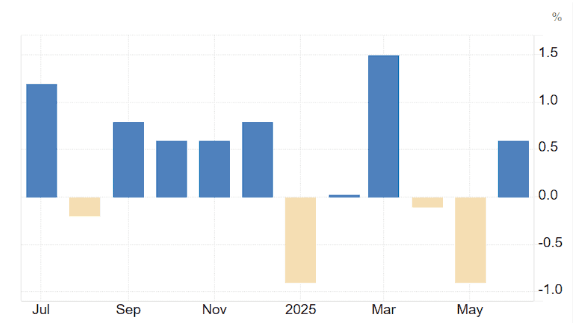




November's 0.10% inflation rate MoM marks a modest rise from October's 0.00% but remains below the 12-month average of 0.15%. This suggests a deceleration from summer peaks but persistent underlying inflation pressures.
Comparing prior months, August and September saw inflation rates of 0.40% and 0.25% respectively, indicating a downward trend into autumn. The November figure aligns with this cooling but signals inflation is not yet fully contained.