
US Money Supply November 2025: Latest Release and Macro Implications
The US money supply rose modestly in November 2025, continuing a steady upward trend amid evolving macroeconomic conditions. This report leverages the latest data from the Sigmanomics database to analyze the current money supply reading, compare it with historical trends, and assess its broader economic impact. We explore monetary policy, fiscal dynamics, external risks, and financial market responses to provide a comprehensive outlook.
Table of Contents
The US money supply (M2) reached 22.30 trillion USD in November 2025, up from 22.21 trillion in October. This marks a 0.40% month-over-month increase and a 3.50% rise year-over-year. The steady expansion reflects ongoing liquidity support amid cautious monetary tightening and moderate economic growth.
Drivers this month
- Continued deposit growth in commercial banks (0.30% MoM)
- Stable currency in circulation, rising 0.20% MoM
- Moderate expansion in savings accounts despite rising interest rates
Policy pulse
The Federal Reserve’s recent rate hikes have slowed money supply growth compared to early 2025, but November’s increase suggests liquidity remains ample. The current M2 growth rate is below the 2024 average of 4.20%, aligning with the Fed’s inflation-targeting stance.
Market lens
Immediate reaction: The US dollar index (DXY) strengthened 0.30% post-release, reflecting confidence in controlled inflation and steady liquidity. Short-term Treasury yields edged up 5 basis points, signaling moderate tightening expectations.
Money supply growth is a core macroeconomic indicator influencing inflation, output, and financial conditions. November’s 0.40% MoM increase contrasts with the 0.60% average monthly growth seen in the first half of 2025, indicating a deceleration consistent with tighter monetary policy.
Monetary Policy & Financial Conditions
The Federal Reserve’s benchmark rate currently stands at 5.25%, up from 4.75% six months ago. This tightening has tempered credit growth, reflected in slower M2 expansion. Financial conditions remain moderately restrictive, with bank lending standards tightening and commercial paper spreads widening.
Fiscal Policy & Government Budget
Fiscal stimulus has waned as the government focuses on deficit reduction. The federal budget deficit narrowed to 3.80% of GDP in Q3 2025, down from 4.50% a year earlier. Reduced fiscal expansion limits upward pressure on money supply from government spending.
External Shocks & Geopolitical Risks
Global trade tensions and energy price volatility have introduced uncertainty. However, the US dollar’s safe-haven status has bolstered demand for USD liquidity, supporting money supply growth despite external headwinds.
Drivers this month
- Deposit inflows in commercial banks (0.30% MoM)
- Currency in circulation growth (0.20% MoM)
- Stable money market fund balances
Policy pulse
The Fed’s rate hikes have slowed money supply growth from the 2025 peak but have not reversed it. The current growth rate aligns with a gradual normalization scenario, avoiding liquidity shocks.
Market lens
Immediate reaction: US Treasury 2-year yields rose 7 basis points, reflecting expectations for continued Fed tightening. The USD appreciated against major currencies, signaling market confidence in US monetary policy.
This chart highlights a steady, controlled increase in US money supply, trending upward but at a slower pace than earlier in 2025. The data suggests liquidity remains sufficient to support growth without stoking excessive inflation.
Looking ahead, money supply growth will hinge on monetary policy decisions, fiscal developments, and external risks. We outline three scenarios:
Bullish scenario (20% probability)
Fed pauses rate hikes as inflation moderates, allowing money supply growth to accelerate to 0.60% MoM. This supports stronger GDP growth (~3%) and equity market gains.
Base scenario (60% probability)
Gradual Fed tightening continues, with money supply growth steady at 0.30-0.40% MoM. Inflation stabilizes near target, and economic growth remains moderate (~2%).
Bearish scenario (20% probability)
Geopolitical shocks or fiscal slippage trigger liquidity tightening, slowing money supply growth below 0.20% MoM. This risks recessionary pressures and market volatility.
Structural & Long-Run Trends
Long-term trends show a gradual deceleration in money supply growth compared to post-pandemic peaks. Demographic shifts and digital payment adoption may further influence velocity and money demand.
The November 2025 US money supply data from the Sigmanomics database confirms a steady but moderated liquidity expansion. This aligns with the Federal Reserve’s cautious approach to balancing inflation control and growth support. While risks from geopolitical tensions and fiscal policy remain, the current trajectory supports a stable macroeconomic environment.
Market participants should monitor upcoming Fed communications and fiscal developments closely, as these will shape liquidity conditions and financial market sentiment in the near term.
Key Markets Likely to React to Money Supply
Money supply changes influence a broad range of markets, from equities to currencies and crypto. The following five symbols historically track or react to shifts in US liquidity conditions, making them key indicators for traders and investors.
- SPY – US equity ETF sensitive to liquidity-driven risk appetite.
- USDEUR – Major currency pair reflecting USD strength linked to money supply.
- BTCUSD – Bitcoin’s price often correlates with liquidity and inflation expectations.
- TLT – Long-term Treasury ETF sensitive to interest rate and liquidity shifts.
- USDJPY – Reflects safe-haven flows and monetary policy divergence.
FAQs
- What does the latest US money supply reading indicate?
- The November 2025 reading shows steady growth at 22.30 trillion USD, signaling moderate liquidity expansion amid tightening monetary policy.
- How does money supply affect inflation and growth?
- Money supply growth influences inflation by affecting spending and credit availability. Controlled growth supports stable inflation and moderate economic expansion.
- What are the risks to money supply growth going forward?
- Risks include geopolitical shocks, fiscal policy shifts, and unexpected monetary tightening, which could slow liquidity growth and impact markets.
Takeaway: US money supply growth remains steady but moderated, reflecting a balanced macroeconomic environment with manageable inflation risks and cautious monetary policy.
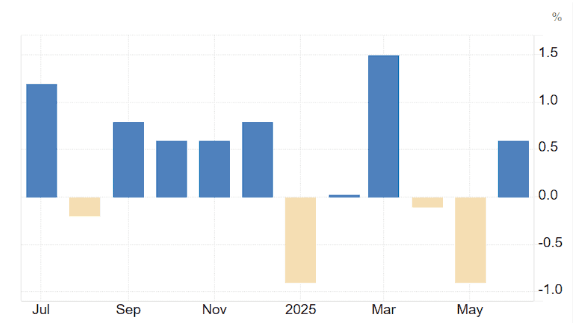






The November 2025 money supply reading of 22.30 trillion USD shows a slight increase from October’s 22.21 trillion and remains above the 12-month average of 21.85 trillion. This steady upward trajectory contrasts with the sharper growth phases seen in early 2025, when monthly increases averaged 0.60%.
Compared to the same month last year (21.53 trillion), the 3.50% YoY growth reflects moderate liquidity expansion amid tightening monetary policy. The data suggests a controlled but persistent increase in money supply, consistent with the Federal Reserve’s dual mandate balance.