July CPI Report Strengthens Case for September Fed Cut

Loading...

And yet, the market appears more focused on the dovish CPI. Both the Nasdaq Composite and the S&P 500 posted record closing highs on the day the CPI data came out. The S&P 500 climbed 13% to close at 6,466.58, and the Nasdaq gained 296.50 points, a 1.39% rise. The Dow also rose by about a similar margin (1.10%) to close at 44,458.61.
\nKatherine Bordlemay of Goldman Sachs Asset Management views this performance as the market voting with its money. The market expects a rate cut in September and doesn’t see how the Fed can ignore the fundamentals. “The CPI data is supportive for equities overall, getting some good news with the Fed looking more on track to cut in September and potentially more transitory inflation,” she said.
\nOne month ago, the market believed there was a 55.9% chance of the Fed cutting the target rate to between 400 and 425 basis points (bps), according to CME’s FedWatch tool. That probability is now 84.9%.
\t\t\t\t\t\t\t\tOne thing the market is right about is that the fundamentals favor a rate cut. This position also happens to be the White House’s view. A day after the July CPI data, Treasury Secretary Scott Bessent told Bloomberg Television that he thought “an aggressive half-point cut was possible given recent weak employment numbers.” “If we’d seen those numbers in May, in June, I suspect we could have had rate cuts in June and July. So that tells me that there’s a very good chance of a 50 basis-point rate cut in September,” he added.
\nSome analysts agree with Bessent and see that a September rate cut is a 100% possibility. BNY’s John Velis believes that the September meeting will be the first of many rate cuts to come. He argues that Trump’s tariff increases will soon start to be reflected in CPI data. He said: “This is still early innings of this process and just as the Fed will be beginning to cut rates in the autumn, that’s when the inflation data will probably start to be registering some of these more direct tariff price increases and it’s going to complicate the rate-cutting decision.”
\nBut others, including the Fed Chair Jerome Powell, see waiting as low risk. Powell has been unwilling to give in to the rate-cut pressure, saying he wants to “wait for more data about how Trump’s tariffs are impacting inflation.” Raphael Bostic’s (Atlanta Fed President) position is that there should be no rush to cut rates. He reasoned that companies are poised to raise prices in reaction to import taxes, and the job market remains firm. As such, he’s comfortable waiting, perhaps until late 2025, for solid evidence of inflation moving toward the 2% target before easing policy.
\nSomething else may complicate the Fed’s decision this September. The Trump administration fired the BLS Chief, Erika McEntarfer, on August 1, just hours after releasing the July jobs report. Many found the report disappointing, with the president aiming criticisms at the BLS and its leadership. In McEntarfer’s place, Trump has nominated E.J. Antoni, an economist at the Heritage Foundation. However, Antoni, like Trump, is a critic of the statistics agency, who, according to a Reuters report, adds “another layer of worry over data quality.” “Economists across political ideologies have described Antoni as unqualified for the position,” Reuters stated.
\nCPI may be at risk, and concerns about data reliability may exist, but this item is undoubtedly a market mover. Michael Ashton, founder of Enduring Investments LLC, has done an analysis that captures the narrative sensitivity of markets to CPI data. This analysis shows that even the modest CPI upticks can shift expectations around rate cuts.
\nAnalysts conclude that there are three Fed trajectory scenarios: baseline, hawkish risk, and dovish tail-risk. The baseline scenario is that there will be a September cut, followed by cautious pacing. Alternatively, the PPI pass-through may revive inflation concerns, prompting the Fed to continue the current posture, which is to pause (hawkish risk). Lastly, labor data may worsen, leading to two cuts by year-end (dovish tail-risk).
\t\t\t\t\t\t\t\tThe Federal Reserve is once again at a crossroads. Inflation is cooling faster than expected, while growth signals are flashing mixed. July’s Consumer Price Index (CPI) data just came out, and it showed a sharper-than-anticipated decline. Now, those inside the Fed’s leadership who favor a rate cut are emboldened. Markets are also pricing in a cut at the September meeting. But does the cooling CPI give the Fed enough room to loosen rates despite other inflationary pressures and labor weakness?
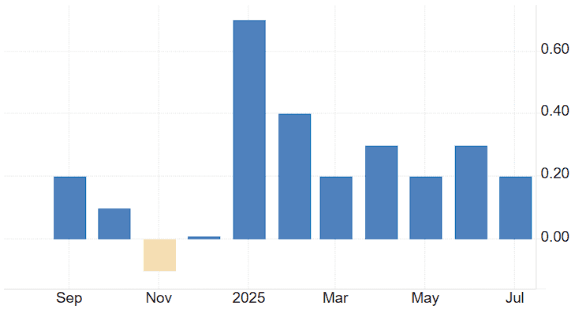
On Tuesday, August 12, the Bureau of Labor Statistics (BLS) released July’s CPI data, and the immediate reaction from observers was that it accelerated slightly less than anticipated. Headline CPI (month-on-month (MoM), seasonally adjusted) increased by 0.2%. This growth is slower than the 0.3% posted in June. On an annual basis, CPI climbed by 2.7%, unchanged from June, but below the 2.8% forecast. On the other hand, the Core CPI (excluding energy and food) rose by 0.3% MoM, its sharpest rise in six months.
Source: Sigmanomics.com
The BLS stated that energy prices were the biggest drag on inflation (gasoline prices fell 2.2% MoM, electricity decreased 0.1%, and natural gas dropped 0.9%). Over the past year, the report said, gasoline prices plunged 9.5%, which offset gains in other categories. Other categories that offset headline inflation are food (the food index barely changed in July: food at home declined 0.1% and food away from home rose modestly by 0.3%) and lodging and communications.
Two days after the CPI release, the BLS released the Producer Price Index (PPI) numbers for July. And it was a surprise. Final demand PPI rose 0.9%, the largest monthly gain in three years. On a 12-month basis, PPI accelerated from June’s 2.4% to 2.7%. The BLS stated that the unexpected PPI performance came on the back of services and food inputs.
Economists point out that the lag between the CPI and PPI suggests that producers may be absorbing rising costs within the economy, or that price pass-through is delayed. But, eventually, the spike could filter into CPI, especially for firms absorbing the costs. Carl Weinberg, chief economist at High Frequency Economics, commented that the PPI data is a “kick in the teeth for anyone who thought that tariffs would not impact domestic prices in the United States economy.” “This report is a strong validation of the Fed’s wait-and-see stance on policy changes,” he added.
And yet, the market appears more focused on the dovish CPI. Both the Nasdaq Composite and the S&P 500 posted record closing highs on the day the CPI data came out. The S&P 500 climbed 13% to close at 6,466.58, and the Nasdaq gained 296.50 points, a 1.39% rise. The Dow also rose by about a similar margin (1.10%) to close at 44,458.61.
Katherine Bordlemay of Goldman Sachs Asset Management views this performance as the market voting with its money. The market expects a rate cut in September and doesn’t see how the Fed can ignore the fundamentals. “The CPI data is supportive for equities overall, getting some good news with the Fed looking more on track to cut in September and potentially more transitory inflation,” she said.
One month ago, the market believed there was a 55.9% chance of the Fed cutting the target rate to between 400 and 425 basis points (bps), according to CME’s FedWatch tool. That probability is now 84.9%.
One thing the market is right about is that the fundamentals favor a rate cut. This position also happens to be the White House’s view. A day after the July CPI data, Treasury Secretary Scott Bessent told Bloomberg Television that he thought “an aggressive half-point cut was possible given recent weak employment numbers.” “If we’d seen those numbers in May, in June, I suspect we could have had rate cuts in June and July. So that tells me that there’s a very good chance of a 50 basis-point rate cut in September,” he added.
Some analysts agree with Bessent and see that a September rate cut is a 100% possibility. BNY’s John Velis believes that the September meeting will be the first of many rate cuts to come. He argues that Trump’s tariff increases will soon start to be reflected in CPI data. He said: “This is still early innings of this process and just as the Fed will be beginning to cut rates in the autumn, that’s when the inflation data will probably start to be registering some of these more direct tariff price increases and it’s going to complicate the rate-cutting decision.”
But others, including the Fed Chair Jerome Powell, see waiting as low risk. Powell has been unwilling to give in to the rate-cut pressure, saying he wants to “wait for more data about how Trump’s tariffs are impacting inflation.” Raphael Bostic’s (Atlanta Fed President) position is that there should be no rush to cut rates. He reasoned that companies are poised to raise prices in reaction to import taxes, and the job market remains firm. As such, he’s comfortable waiting, perhaps until late 2025, for solid evidence of inflation moving toward the 2% target before easing policy.
Something else may complicate the Fed’s decision this September. The Trump administration fired the BLS Chief, Erika McEntarfer, on August 1, just hours after releasing the July jobs report. Many found the report disappointing, with the president aiming criticisms at the BLS and its leadership. In McEntarfer’s place, Trump has nominated E.J. Antoni, an economist at the Heritage Foundation. However, Antoni, like Trump, is a critic of the statistics agency, who, according to a Reuters report, adds “another layer of worry over data quality.” “Economists across political ideologies have described Antoni as unqualified for the position,” Reuters stated.
CPI may be at risk, and concerns about data reliability may exist, but this item is undoubtedly a market mover. Michael Ashton, founder of Enduring Investments LLC, has done an analysis that captures the narrative sensitivity of markets to CPI data. This analysis shows that even the modest CPI upticks can shift expectations around rate cuts.
Analysts conclude that there are three Fed trajectory scenarios: baseline, hawkish risk, and dovish tail-risk. The baseline scenario is that there will be a September cut, followed by cautious pacing. Alternatively, the PPI pass-through may revive inflation concerns, prompting the Fed to continue the current posture, which is to pause (hawkish risk). Lastly, labor data may worsen, leading to two cuts by year-end (dovish tail-risk).

Neha Gupta is a Chartered Financial Analyst with over 18 years of experience in finance and more than 11 years as a financial writer. She’s authored for clients worldwide, including platforms like MarketWatch, TipRanks, InsiderMonkey, and Seeking Alpha. Her work is known for its technical rigor, clear communication, and compliance-awareness—evident in her success enhancing market updates.