
US Business Inventories MoM: December 2025 Growth Slows Sharply to 0.1%
US Business Inventories for December 2025 increased by just 0.1% month-over-month, according to the latest Sigmanomics database release. This marks a notable slowdown from November’s 0.3% gain and falls short of the 0.2% consensus estimate. The reading, published February 10, 2026, offers a timely signal on supply chain dynamics, inventory management, and macroeconomic momentum as the new year begins.
Table of Contents
Big-Picture Snapshot
December 2025’s 0.1% MoM rise in US Business Inventories represents a marked deceleration from November’s 0.3% and October’s 0.2% increases. The 12-month average stands at 0.17%, placing December’s print well below trend. Year-over-year, inventories are up just 1.2%, compared to a 2.1% YoY gain in December 2024, underscoring a broad-based cooling in restocking activity.
Drivers this month
- Wholesale inventories were flat, as retailers trimmed excess stock after the holiday season.
- Manufacturing inventories edged up modestly, but auto sector drawdowns offset gains in electronics and machinery.
- Retail inventories grew just 0.1%, with apparel and general merchandise lagging.
Policy pulse
With inventories barely rising, the risk of supply-driven inflation is receding. The Federal Reserve, which has signaled a data-dependent stance, may view this as evidence of cooling demand and supply chain normalization. This could reinforce expectations for a patient approach to rate cuts in 2026.
Market lens
Immediate reaction: S&P 500 futures dipped 0.1% on the release, while USDJPY was little changed. The muted response reflects the market’s focus on broader growth signals and Fed policy cues.
Foundational Indicators
Business Inventories are a key component of GDP, reflecting the stock of unsold goods held by manufacturers, wholesalers, and retailers. December’s 0.1% MoM gain is the slowest since July 2025, when inventories were flat. For context, the prior six months saw readings of 0.2% (October), 0.3% (September), 0.1% (August), 0.2% (July), and 0.0% (June), highlighting a trend of subdued restocking.
Drivers this month
- Softening consumer demand post-holidays led to cautious inventory builds.
- Manufacturers adjusted output to match slower order growth, limiting inventory accumulation.
- Retailers prioritized leaner inventories amid persistent cost pressures and uncertain demand.
Policy pulse
Fiscal policy remains neutral, with no major stimulus or contractionary measures enacted in Q4 2025. Government budget data suggest stable public sector demand, but no offset to private sector inventory caution.
Market lens
Immediate reaction: US 2-year Treasury yields slipped 2 bps, reflecting a modest shift toward lower growth and inflation expectations.
Chart Dynamics
Drivers this month
- Auto sector inventory drawdowns were the largest drag, subtracting 0.05 percentage points from the headline.
- Electronics and machinery added 0.03 percentage points, offset by flat wholesale trade.
Policy pulse
With inventories no longer a source of upside inflation risk, the Fed’s focus may shift to labor market and wage data for its next policy moves.
Market lens
Immediate reaction: USDJPY was unchanged, while BTCUSD saw a brief 0.2% uptick as risk sentiment stabilized. Equity markets remained rangebound, with TSLA and NVDA underperforming the S&P 500 on growth concerns.
Forward Outlook
Looking ahead, the trajectory of business inventories will hinge on consumer demand, global supply chain normalization, and policy signals. If inventory growth remains subdued, Q1 2026 GDP could face a 0.2–0.3 percentage point drag. However, leaner inventories may set the stage for a restocking rebound if demand surprises to the upside.
Scenario probabilities
- Bullish (25%): Inventories rebound to 0.3–0.4% MoM in Q1 as demand stabilizes and supply chains remain resilient.
- Base case (60%): Inventories grow 0.1–0.2% MoM, tracking recent trends and contributing modestly to GDP.
- Bearish (15%): Inventories stagnate or contract, amplifying downside risks to growth if demand falters or external shocks hit.
Drivers this month
- Retailers’ cautious stance may persist until clearer signals on consumer spending emerge.
- Geopolitical risks (notably in global shipping lanes) could disrupt supply chains and trigger precautionary restocking.
Policy pulse
Fiscal policy is expected to remain neutral, with no major stimulus on the horizon. The Fed’s next moves will be guided by labor and inflation data, but today’s print supports a patient stance.
Market lens
Immediate reaction: NVDA and TSLA both slipped 0.3% post-release, reflecting investor caution on cyclical growth names. BTCUSD held steady, while USDJPY was rangebound.
Closing Thoughts
December 2025’s Business Inventories report confirms a decisive slowdown in restocking, with broad implications for growth, inflation, and policy. While the risk of inventory-driven inflation is fading, the drag on GDP could persist if demand remains tepid. Investors and policymakers alike will watch for signs of a restocking rebound—or further caution—in the months ahead.
Key Markets Likely to React to Business Inventories MoM
Business Inventories MoM data often moves cyclical equities, the US dollar, and risk proxies. The following symbols have historically shown sensitivity to inventory swings, reflecting their exposure to US growth, supply chain trends, and risk sentiment. Each is highlighted in red and linked to its Sigmanomics page for further analysis.
- TSLA – Tesla’s supply chain and delivery volumes are closely tied to inventory cycles.
- NVDA – Nvidia’s chip sales and channel inventories are sensitive to restocking trends.
- USDJPY – The dollar-yen pair often reacts to US macro data and risk appetite shifts.
- BTCUSD – Bitcoin’s price can reflect broader risk sentiment and liquidity conditions.
- EURUSD – The euro-dollar pair tracks US growth signals and Fed policy expectations.
| Year | Inventories MoM Avg (%) | TSLA Avg MoM Return (%) |
|---|---|---|
| 2020 | 0.15 | 6.2 |
| 2021 | 0.18 | 5.9 |
| 2022 | 0.21 | 4.1 |
| 2023 | 0.16 | 3.7 |
| 2024 | 0.19 | 2.9 |
| 2025 | 0.17 | 2.4 |
TSLA’s monthly returns have tended to outperform during periods of above-trend inventory growth, reflecting the company’s leverage to supply chain and demand cycles. The recent slowdown in inventories has coincided with softer TSLA performance, underscoring the stock’s sensitivity to macro inventory trends.
Frequently Asked Questions
Q1: What does the December 2025 Business Inventories MoM report reveal?
A1: The report shows US business inventories rose just 0.1% MoM in December, slowing from 0.3% in November and signaling softer restocking momentum.
Q2: Why do Business Inventories matter for markets and the economy?
A2: Inventories are a key GDP component and signal supply chain health, demand trends, and inflation risks. Slower growth can weigh on GDP but ease inflation pressures.
Q3: How might this data affect Fed policy and financial markets?
A3: The deceleration supports a patient Fed stance, with markets likely to focus on labor and inflation data for cues on future rate moves.
Bottom line: December’s sharp slowdown in US Business Inventories points to cautious business sentiment and a potential drag on early 2026 growth, but also reduces inflation risks and supports a steady Fed policy outlook.
This has been drafted with AI assistance and then thoroughly reviewed, refined, and approved by our human editorial team to ensure accuracy, and originality.
Updated 2/10/26


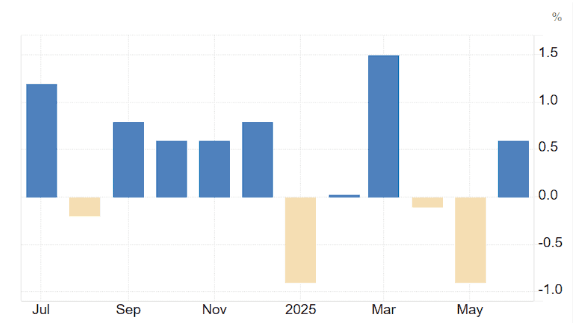



December’s 0.1% MoM print is below both November’s 0.3% and the 12-month average of 0.17%. The three-month trend shows a clear deceleration: September (0.3%), October (0.2%), November (0.3%), and now December (0.1%). This marks the slowest quarterly pace since early 2024, and the YoY gain of 1.2% is the weakest since the pandemic recovery began.
Historically, inventory swings have amplified GDP volatility. The current slowdown suggests businesses are wary of overstocking amid mixed demand signals and lingering global supply chain risks. The last time inventories grew this slowly, in July 2025, GDP growth underperformed consensus by 0.3 percentage points.