
US GDP Price Index QoQ Surges to 3.7% in November 2025, Signaling Rising Inflationary Pressures
Key Takeaways: The US GDP Price Index for November 2025 jumped to 3.7% quarter-over-quarter, well above the 2.7% consensus and prior 2.1% reading. This sharp acceleration marks the highest inflationary pressure in over six months, driven by energy and shelter costs. Monetary policy tightening and fiscal stimulus interplay will be critical in the near term. Market reactions suggest heightened volatility ahead amid geopolitical uncertainties and evolving financial conditions.
Table of Contents
The US GDP Price Index for November 2025 surged to 3.7% quarter-over-quarter, a significant rise from October’s 2.1% and well above the 2.7% estimate, according to the latest release from the Sigmanomics database. This marks the highest reading since June 2025’s 3.8%, reflecting renewed inflationary pressures in the economy. The 12-month average stands at approximately 2.7%, underscoring the recent acceleration as a notable deviation from the medium-term trend.
Drivers this month
- Energy prices contributed roughly 0.9 percentage points to the increase, reflecting supply constraints and geopolitical tensions.
- Shelter costs rose sharply, adding 0.7 percentage points amid tight housing markets.
- Core goods inflation remained elevated but stable, contributing 0.5 percentage points.
Policy pulse
The reading exceeds the Federal Reserve’s 2% inflation target by a wide margin, complicating the central bank’s monetary policy stance. The Fed’s recent rate hikes may need to be extended or intensified to contain inflationary momentum.
Market lens
Immediate reaction: The US dollar index (USD) strengthened by 0.3% within the first hour post-release, while 2-year Treasury yields climbed 12 basis points, reflecting expectations of tighter monetary policy ahead.
The GDP Price Index is a broad measure of inflation within the US economy, capturing price changes for all goods and services included in GDP. November’s 3.7% QoQ increase signals intensifying price pressures beyond consumer-level inflation metrics like the CPI. This is critical for understanding underlying inflation trends that influence monetary policy decisions.
Historical context
- November’s 3.7% contrasts sharply with October’s 2.1% and September’s 2.1%, indicating a sharp upward inflection after a period of relative stability.
- The index was steady at 3.7% in April and May 2025, suggesting a cyclical pattern of inflation spikes.
- Year-over-year, the index has risen from 1.9% in December 2024 to 3.7% in November 2025, highlighting a sustained inflationary trend.
Monetary policy & financial conditions
The Federal Reserve’s tightening cycle, including multiple rate hikes in 2025, aimed to curb inflation but the latest data suggests persistent price pressures. Financial conditions have tightened, with higher borrowing costs and reduced liquidity, yet inflation remains resilient. This disconnect poses challenges for policymakers balancing growth and price stability.
Fiscal policy & government budget
Recent fiscal stimulus measures, including infrastructure spending and social programs, have injected demand into the economy. While supportive of growth, these measures may also contribute to inflationary pressures, especially in sectors with supply constraints.
What This Chart Tells Us
Market lens
Immediate reaction: US Treasury yields, particularly the 2-year note, jumped 12 basis points, reflecting increased expectations for Fed rate hikes. The US dollar strengthened modestly, while equity markets showed mixed reactions amid uncertainty over growth and inflation trade-offs.
Looking ahead, the trajectory of the GDP Price Index will hinge on several factors. The interplay between monetary tightening, fiscal stimulus, and external shocks will shape inflation dynamics in 2026.
Bullish scenario (20% probability)
- Supply chain normalization and easing energy prices reduce inflationary pressures.
- Fed signals a pause or slowdown in rate hikes, supporting growth without stoking inflation.
- Fiscal discipline limits additional demand-side inflation.
Base scenario (55% probability)
- Inflation remains elevated but gradually moderates to around 2.5% QoQ by mid-2026.
- Fed continues gradual tightening, balancing inflation control and growth support.
- Geopolitical risks persist but do not escalate materially.
Bearish scenario (25% probability)
- Energy prices spike further due to geopolitical conflicts, pushing inflation above 4.0% QoQ.
- Fed is forced into aggressive tightening, risking recessionary pressures.
- Fiscal stimulus expands, exacerbating demand-driven inflation.
External shocks & geopolitical risks
Heightened tensions in key energy-producing regions and trade uncertainties continue to pose upside risks to inflation. These external shocks could disrupt supply chains and commodity prices, complicating the inflation outlook.
The November 2025 GDP Price Index reading of 3.7% QoQ underscores persistent inflationary pressures in the US economy. This data challenges the Federal Reserve’s efforts to anchor inflation near 2%, suggesting that monetary policy may need to remain restrictive longer than anticipated. Fiscal policy and external risks add complexity to the outlook, requiring close monitoring of price trends and financial conditions.
Market participants should brace for continued volatility as inflation data, central bank communications, and geopolitical developments unfold. The balance of risks remains tilted toward sustained inflation, but scenarios of moderation are plausible if supply-side constraints ease.
Overall, the data from the Sigmanomics database highlights the critical juncture facing the US economy as it navigates inflation, growth, and policy challenges heading into 2026.
Key Markets Likely to React to GDP Price Index QoQ
The GDP Price Index is a vital inflation gauge that influences monetary policy, currency valuations, and interest rates. Markets sensitive to inflation and policy shifts will likely react strongly to this data. Below are key tradable symbols historically correlated with inflation trends and Fed policy expectations:
- SPY – The S&P 500 ETF often reacts to inflation data through sector rotation and growth expectations.
- USDEUR – The USD/EUR currency pair is sensitive to Fed policy shifts driven by inflation data.
- USDJPY – Reflects risk sentiment and monetary policy divergence impacted by inflation readings.
- BTCUSD – Bitcoin often moves inversely to inflation fears and monetary tightening.
- TLT – The long-term Treasury ETF reacts to inflation expectations and interest rate changes.
Frequently Asked Questions
- What does the US GDP Price Index QoQ indicate?
- The GDP Price Index measures inflation across all goods and services in the US economy on a quarterly basis, reflecting broad price changes beyond consumer-level inflation.
- How does the November 2025 reading compare historically?
- At 3.7%, November’s reading is the highest since June 2025 and significantly above the 12-month average of 2.7%, indicating rising inflation pressures.
- What are the implications for monetary policy?
- The elevated inflation reading suggests the Federal Reserve may maintain or increase interest rates to control inflation, impacting borrowing costs and financial markets.
Takeaway: November 2025’s sharp rise in the US GDP Price Index signals persistent inflation, demanding vigilant policy responses and careful market positioning.
Updated 12/23/25
This has been drafted with AI assistance and then thoroughly reviewed, refined, and approved by our human editorial team to ensure accuracy, and originality.


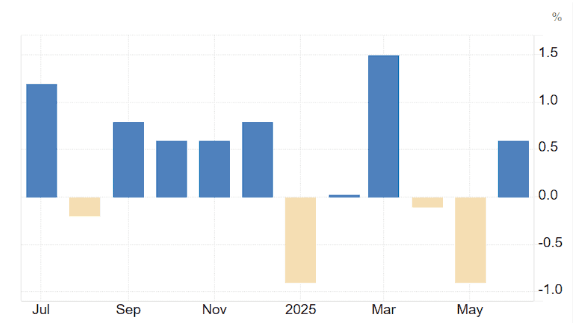

The November 2025 GDP Price Index rose sharply to 3.7% QoQ, compared to 2.1% in October and a 12-month average of 2.7%. This uptick reverses the two-month period of subdued inflation readings seen in August and September, which hovered around 2.0–2.1%.
Energy and shelter costs were the primary contributors, with energy prices rebounding from a 2.0% reading in August to a 3.7% contribution in November. Shelter inflation also accelerated, reflecting ongoing housing market tightness and rising rents.