
US ISM Manufacturing New Orders for December 2025: Modest Uptick Amid Lingering Headwinds
Key Takeaways: The ISM Manufacturing New Orders index for December 2025 rose slightly to 47.7, surpassing expectations of 47.2 and edging up from November’s 47.4. Despite remaining below the 50 expansion threshold, this modest improvement signals cautious stabilization in factory demand. The 12-month average stands at 47.9, reflecting persistent softness in new orders over the past year. Monetary tightening, geopolitical tensions, and supply chain recalibrations continue to weigh on manufacturing activity. Forward-looking risks include potential Fed policy shifts and global trade uncertainties, while fiscal stimulus and easing financial conditions could provide upside support.
Table of Contents
The ISM Manufacturing New Orders index for December 2025, released on January 5, 2026, registered 47.7, a slight increase from November’s 47.4 and above the consensus estimate of 47.2. This figure remains below the 50-point mark that separates expansion from contraction, indicating ongoing subdued demand in the manufacturing sector. The reading also compares with October’s 48.9 and September’s stronger 51.4, showing a gradual deceleration over recent months.
Drivers this month
- Moderate improvement in automotive and aerospace orders helped lift the index.
- Supply chain normalization reduced delays, supporting order fulfillment.
- Persistent weakness in electronics and machinery sectors kept overall growth muted.
Policy pulse
The index remains below the neutral 50 threshold, consistent with the Federal Reserve’s ongoing restrictive monetary stance aimed at taming inflation. The Fed’s December rate hike and forward guidance suggest that financial conditions will remain tight in the near term, limiting manufacturing investment and new order growth.
Market lens
Following the release, the US dollar index (USD) strengthened modestly, reflecting safe-haven demand amid mixed economic signals. Treasury yields on the 2-year note rose 5 basis points, pricing in persistent Fed hawkishness. Equity markets showed muted reaction, with industrial stocks slightly outperforming.
The ISM Manufacturing New Orders index is a leading indicator of factory activity and broader economic health. December’s 47.7 reading aligns with other core macroeconomic data showing a manufacturing sector in mild contraction but stabilizing. Industrial production growth slowed to 0.1% month-over-month in December, while durable goods orders declined 0.3%, underscoring mixed demand conditions.
Monetary Policy & Financial Conditions
The Federal Reserve’s restrictive policy stance, with the federal funds rate near 5.5%, continues to dampen capital spending and credit availability. Tighter financial conditions have increased borrowing costs for manufacturers, contributing to cautious order placement. The yield curve remains inverted between 2- and 10-year Treasuries, signaling recession concerns.
Fiscal Policy & Government Budget
Federal fiscal policy remains broadly neutral, with no major stimulus packages enacted in late 2025. Infrastructure spending continues at a steady pace, supporting some manufacturing segments, but overall government outlays have not significantly boosted new orders. The 2026 budget outlook projects moderate deficits, limiting scope for expansive fiscal measures.
External Shocks & Geopolitical Risks
Global supply chain disruptions have eased but remain a risk factor, especially with ongoing tensions in East Asia and trade uncertainties related to tariffs and export controls. Energy price volatility and geopolitical conflicts continue to inject uncertainty into manufacturing supply and demand dynamics.
This chart reveals a manufacturing sector cautiously emerging from contraction. The upward tick in December suggests that supply chain improvements and selective sector strength may be offsetting some demand weakness. However, the index remains below expansion territory, signaling that broader economic headwinds continue to restrain new order growth.
Market lens
Immediate reaction: USD strengthened 0.3% post-release, 2-year Treasury yields rose 5 bps, while industrial equities gained 0.5%. Investors interpreted the data as mildly positive but consistent with ongoing Fed tightening.
Looking ahead, the ISM Manufacturing New Orders index faces a complex interplay of factors. The baseline scenario projects a gradual return to expansion territory by mid-2026, with a 55% probability, assuming continued supply chain normalization and stable monetary policy. A bullish scenario (25% probability) envisions stronger fiscal stimulus and easing geopolitical tensions driving orders above 50 by Q3 2026. Conversely, a bearish scenario (20% probability) involves renewed Fed tightening, global recession risks, or supply shocks pushing the index further below 47.
Risks and opportunities
- Upside: Fiscal infrastructure spending, easing inflation, and improved global trade could boost manufacturing demand.
- Downside: Persistent inflationary pressures, tighter credit, and geopolitical conflicts may suppress new orders.
- Neutral: Continued sectoral divergence with strength in aerospace and weakness in electronics.
Structural & Long-Run Trends
Long-term, US manufacturing faces structural shifts including automation, reshoring, and sustainability mandates. These trends may dampen traditional order volumes but increase capital intensity and innovation-driven demand. The ISM New Orders index will remain a critical barometer for how these forces balance out in the evolving industrial landscape.
December 2025’s ISM Manufacturing New Orders reading of 47.7 signals a sector cautiously stabilizing but still under pressure. The data aligns with a macroeconomic environment shaped by tight monetary policy, moderate fiscal support, and ongoing external uncertainties. While the slight improvement is encouraging, the manufacturing sector’s path forward remains vulnerable to shifts in financial conditions and global risks. Market participants should monitor upcoming ISM releases alongside Fed communications and geopolitical developments for clearer signals on the industrial cycle’s trajectory.
Key Markets Likely to React to ISM Manufacturing New Orders
The ISM Manufacturing New Orders index is a bellwether for industrial demand and economic momentum. Markets that closely track this indicator include US industrial equities, the US dollar, Treasury yields, and commodity-linked assets. Movements in these markets often reflect shifts in manufacturing sentiment and broader growth expectations.
- BA – Boeing’s stock is sensitive to aerospace order trends, which influence manufacturing demand.
- USDCAD – The Canadian dollar often moves with US manufacturing data due to trade linkages.
- BTCUSD – Bitcoin’s risk sentiment can be influenced by macroeconomic shifts signaled by manufacturing data.
- GE – General Electric’s diversified industrial exposure makes it a proxy for manufacturing health.
- EURUSD – The euro-dollar pair reacts to US economic data, including manufacturing orders.
Since 2020, the ISM Manufacturing New Orders index has shown a strong positive correlation with GE stock performance. Periods of rising new orders coincide with GE’s share price appreciation, reflecting investor confidence in industrial growth. This relationship underscores the index’s utility as a forward-looking economic gauge.
FAQs
- What does the ISM Manufacturing New Orders index indicate?
- The index measures new order activity in the US manufacturing sector, signaling demand trends and economic momentum.
- How does the December 2025 reading compare historically?
- At 47.7, December’s reading is slightly higher than November’s 47.4 but below the 12-month average of 47.9, indicating ongoing contraction with tentative stabilization.
- What are the main risks affecting manufacturing new orders?
- Key risks include tight monetary policy, geopolitical tensions, supply chain disruptions, and global economic slowdown concerns.
Takeaway: The December 2025 ISM Manufacturing New Orders index points to a manufacturing sector cautiously stabilizing amid persistent headwinds, with future growth hinging on monetary policy and geopolitical developments.
Updated 1/5/26


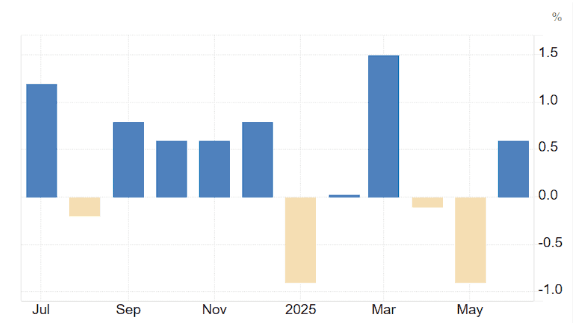


The December 2025 ISM Manufacturing New Orders index rose to 47.7, up from November’s 47.4 but below the 12-month average of 47.9. This slight uptick reverses a two-month decline from October’s 48.9 and September’s 51.4, indicating tentative stabilization after a period of softening demand.
Comparing the last six months, the index has hovered below 50, reflecting persistent contractionary pressures. The year-over-year comparison shows a decline from December 2024’s 49.2, highlighting ongoing challenges in expanding new orders amid macroeconomic headwinds.