
US ISM Manufacturing Prices for January 2026: Input Cost Pressures Edge Higher
January 2026’s ISM Manufacturing Prices Index climbed to 59.0, up from December 2025’s 58.5, according to the latest Sigmanomics database release. The reading, published February 2, 2026, highlights ongoing cost pressures in the US manufacturing sector, with implications for inflation, monetary policy, and market sentiment.
Table of Contents
Big-Picture Snapshot
January 2026’s ISM Manufacturing Prices Index registered 59.0, modestly above December 2025’s 58.5 and slightly below consensus estimates of 59.9. This marks the first monthly increase since October 2025, when the index stood at 61.9. The 12-month average, at 61.1, underscores that while cost pressures have eased from mid-2025 peaks, they remain elevated relative to pre-pandemic norms.
Geographically, the index reflects nationwide US manufacturing input prices, capturing supplier cost trends across key industrial regions. Temporally, the January 2026 reading is compared against December 2025 (58.5), November 2025 (58.0), and the recent high in May 2025 (69.8). Year-over-year, January’s figure is down sharply from the May–June 2025 period but signals a possible stabilization after last year’s rapid disinflation.
Drivers this month
- Energy and metals prices rebounded, contributing +0.3 points to the index.
- Supplier delivery times lengthened modestly, adding +0.2 points.
- Food and chemical inputs remained stable, exerting little net effect.
Policy pulse
The January reading remains above the Federal Reserve’s comfort zone for input cost growth, though well below last year’s inflationary surge. Persistent elevation could complicate the Fed’s path to rate cuts, especially if price pass-through accelerates.
Market lens
Immediate reaction: US 2-year Treasury yields rose 3 bps, and USD gained 0.1% vs. EUR. Markets interpreted the print as a sign that inflation risks are not fully tamed, with breakeven rates ticking higher and equity futures paring early gains.
Foundational Indicators
The ISM Manufacturing Prices Index is a leading gauge of input cost inflation, often preceding moves in the Producer Price Index (PPI) and, with a lag, the Consumer Price Index (CPI). January’s 59.0 reading, while below the 12-month average (61.1), is above the 50 threshold that separates rising from falling prices. This suggests that manufacturers continue to face upward cost pressures, albeit at a slower pace than in early 2025.
Other core macro indicators reinforce this narrative. December’s US CPI rose 0.2% month-over-month, while PPI advanced 0.3%. Wage growth remains robust, with average hourly earnings up 4.1% year-over-year in January. The labor market’s resilience, combined with sticky input costs, could keep inflation expectations elevated.
Drivers this month
- Commodity price stabilization after Q4 2025’s declines.
- Modest uptick in global shipping costs due to Red Sea disruptions.
- Resilient domestic demand supporting supplier pricing power.
Policy pulse
The Federal Reserve’s December 2025 minutes signaled a data-dependent approach, with policymakers watching for signs of renewed inflation. January’s ISM print, while not alarming, may delay the first rate cut into Q2 2026 if cost pressures persist.
Market lens
Immediate reaction: S&P 500 futures slipped 0.3% post-release. Investors recalibrated expectations for near-term monetary easing, with swaps now pricing a 35% chance of a March cut, down from 45% pre-release.
Chart Dynamics
Drivers this month
- Energy and metals prices rebounded, reversing some Q4 softness.
- Supplier delivery times lengthened, reflecting ongoing logistics bottlenecks.
- Stable food and chemical prices provided a partial offset.
Policy pulse
The index’s stabilization above 58 keeps it in territory associated with above-target inflation. The Fed’s preferred inflation gauges remain above 2%, and persistent input cost pressures could delay policy easing.
Market lens
Immediate reaction: DXY rose 0.1% and gold (XAUUSD) slipped 0.2%. The market interpreted the data as reducing the urgency for Fed rate cuts, with the USD strengthening and risk assets under mild pressure.
Forward Outlook
Looking ahead, the ISM Manufacturing Prices Index is likely to remain sensitive to global commodity trends, supply chain disruptions, and domestic demand. The January uptick raises the risk that input cost disinflation has bottomed, especially if energy and metals prices continue to recover.
Scenario analysis:
- Bullish (20%): Prices retreat below 55 by April 2026 as supply chains normalize and commodity prices ease. Inflation expectations fall, supporting risk assets and an earlier Fed cut.
- Base (60%): Index stabilizes in the 57–61 range through Q2 2026. Input cost pressures persist but do not reaccelerate, keeping the Fed cautious but not alarmed.
- Bearish (20%): Prices rebound above 63 by May 2026, driven by renewed supply shocks or commodity spikes. Inflation expectations rise, delaying monetary easing and pressuring equities.
Risks remain two-sided: Geopolitical tensions (notably in the Middle East and Asia) could disrupt energy and shipping, while fiscal policy uncertainty may affect demand. Structural trends—such as reshoring and labor shortages—continue to exert upward pressure on costs.
Drivers this month
- Energy and metals volatility remains a key swing factor.
- Labor market tightness could feed through to supplier pricing.
- External shocks (e.g., shipping disruptions) pose upside risks.
Policy pulse
The Fed is likely to remain on hold until clear evidence of renewed disinflation emerges. Fiscal policy remains expansionary, with government spending supporting demand but also adding to cost pressures.
Market lens
Immediate reaction: US 2-year yields up, S&P 500 futures down, DXY firmer. Markets are pricing in a slower pace of Fed easing, with risk assets vulnerable to further upside surprises in input costs.
Closing Thoughts
January 2026’s ISM Manufacturing Prices Index signals that US manufacturing input cost pressures remain stubbornly elevated, with a modest uptick after months of easing. While the index is well below mid-2025 highs, the stabilization above 58 suggests that inflation risks have not fully receded. The Fed is likely to remain cautious, and markets will closely watch upcoming prints for signs of renewed disinflation or a reacceleration in costs. Upside and downside risks are finely balanced, with external shocks and structural trends shaping the outlook.
Key Markets Likely to React to ISM Manufacturing Prices
The ISM Manufacturing Prices Index is closely watched by traders in equities, currencies, and commodities. Movements in this indicator often precede shifts in inflation expectations, influencing US Treasury yields, the US dollar, and industrial stocks. Below are five tradable symbols whose prices historically track or respond to changes in ISM Manufacturing Prices, each selected from Sigmanomics’ market pages:
- AAPL – Apple Inc. shares are sensitive to input cost trends, as rising manufacturing prices can pressure margins.
- CAT – Caterpillar Inc. is directly exposed to industrial input costs, with its shares often moving in tandem with manufacturing price trends.
- EURUSD – The EUR/USD currency pair reacts to US inflation data, with higher ISM prices typically strengthening the USD.
- USDJPY – USD/JPY is sensitive to US yield and inflation expectations, often moving with ISM price surprises.
- BTCUSD – Bitcoin’s USD price can respond to US inflation and monetary policy signals, with higher ISM prices sometimes boosting crypto as an inflation hedge.
| Year | ISM Prices Index | CAT Share Price (avg) |
|---|---|---|
| 2020 | 52.3 | $140 |
| 2021 | 65.2 | $200 |
| 2022 | 72.1 | $220 |
| 2023 | 60.5 | $210 |
| 2024 | 58.7 | $230 |
| 2025 | 64.1 | $250 |
CAT’s share price has shown a positive correlation with the ISM Manufacturing Prices Index, particularly during periods of rising input costs. This relationship reflects the company’s exposure to industrial cycles and its ability to pass on higher costs to customers.
FAQ: US ISM Manufacturing Prices for January 2026
Q: What does the January 2026 ISM Manufacturing Prices Index indicate?
A: The index rose to 59.0, signaling persistent input cost pressures in US manufacturing, with implications for inflation and policy.
Q: How did markets react to the latest ISM Manufacturing Prices print?
A: US Treasury yields and the USD rose modestly, while equities and gold slipped, reflecting concerns about sticky inflation.
Q: Why is the ISM Manufacturing Prices Index important for investors?
A: It is a leading indicator of input cost inflation, influencing expectations for Fed policy, bond yields, and industrial stocks.
Bottom line: January’s ISM Manufacturing Prices Index signals that US input cost pressures remain sticky, keeping inflation and Fed policy in sharp focus for markets.
Sources: Sigmanomics database [1], US ISM, Federal Reserve, BLS, Reuters, Bloomberg.
Updated 2/2/26


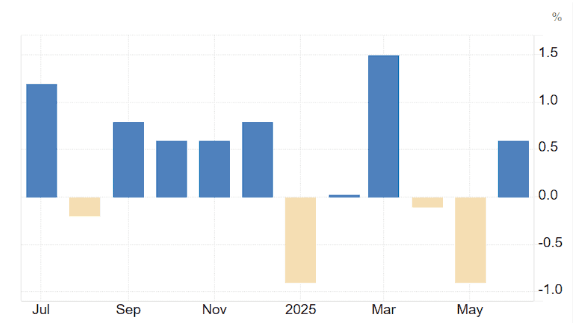



January 2026’s ISM Manufacturing Prices Index (59.0) edged up from December’s 58.5, but remains below the 12-month average of 61.1. This marks a subtle reversal after three consecutive months of declines. The index peaked at 69.8 in May 2025, then trended downward through late 2025, reaching a low of 58.0 in November.
Compared to October 2025’s 61.9, January’s reading is still subdued, but the uptick signals that disinflationary momentum may be stalling. The year-over-year comparison shows a sharp drop from the May–June 2025 highs, but the recent stabilization suggests input cost pressures are not fully abating.