
U.S. Retail Sales YoY: January 2026 Growth Slows Sharply to 2.4%
U.S. Retail Sales YoY for January 2026 registered a 2.4% increase, released on February 10, 2026. This marks a notable slowdown from December 2025’s 3.3% and falls short of consensus estimates of 2.9%[1]. The latest reading is the weakest since June 2023, raising questions about the durability of U.S. consumer demand as macroeconomic crosswinds intensify.
Table of Contents
Big-Picture Snapshot
January 2026’s U.S. Retail Sales YoY growth of 2.4% underscores a marked deceleration in consumer spending momentum. This figure trails both the prior month’s 3.3% and the 12-month average of 3.96%. For context, retail sales growth peaked at 5.2% in May 2025 and has since trended lower, with readings of 3.9% in August, 4.3% in November, and 3.5% in December 2025. The January print is the lowest since June 2023, when growth last dipped below 2.5%.
Drivers this month
- Softening discretionary spending, especially in apparel and electronics
- Persistently high borrowing costs weighing on big-ticket purchases
- Slower wage growth and fading fiscal stimulus effects
Policy pulse
The reading sits well below the Federal Reserve’s comfort zone for robust consumption, reinforcing the case for a cautious monetary stance. With inflation moderating but still above target, policymakers face a delicate balancing act.
Market lens
Immediate reaction: S&P 500 futures slipped 0.3% and USD weakened modestly against major peers. The softer-than-expected print fueled bets on earlier Fed rate cuts, with 2-year Treasury yields falling 6 basis points in the first hour after release.
Foundational Indicators
Retail sales are a bellwether for U.S. economic health, accounting for roughly two-thirds of GDP via consumer spending. January’s 2.4% YoY growth is the slowest since June 2023 and well below the 2025 monthly average of 4.0%. The last six months show a clear downtrend: September 2025 (5.0%), November (4.3%), December (3.3%), and now January (2.4%).
Drivers this month
- Rising credit card delinquencies and tighter lending standards
- Cooling labor market, with job gains moderating since Q4 2025
- Energy prices stabilizing, but food inflation remains sticky
Policy pulse
Fiscal support has faded, with pandemic-era savings largely depleted. The federal budget deficit remains elevated, but new stimulus is unlikely in an election year. The Fed’s restrictive policy stance continues to filter through to consumer credit and sentiment.
Market lens
Bond yields fell as investors priced in a higher probability of mid-2026 rate cuts. The U.S. dollar index (DXY) edged lower, while consumer discretionary stocks underperformed the broader market.
Chart Dynamics
Drivers this month
- Retailers reported weaker foot traffic and online sales, especially in home furnishings and electronics
- Auto sales plateaued after a strong Q4 2025
- Discounting activity increased, eroding nominal sales growth
Policy pulse
The Fed’s restrictive policy is biting, but inflation remains above the 2% target. Policymakers are likely to remain data-dependent, watching for further signs of consumer fatigue before pivoting.
Market lens
Immediate reaction: EURUSD rose 0.2% as U.S. growth concerns mounted. Equity volatility ticked higher, and gold prices firmed as investors sought safety.
Forward Outlook
The sharp deceleration in retail sales growth raises the odds of a softer Q1 2026 GDP print. Consumer sentiment surveys point to rising caution, while credit conditions remain tight. Upside risks include a potential Fed pivot to rate cuts by mid-2026 and a rebound in real incomes if inflation continues to moderate. Downside risks stem from persistent labor market weakness, renewed energy price shocks, or a global demand slowdown.
Bullish scenario (25% probability):
Retail sales stabilize near 3% YoY as the Fed cuts rates by June, boosting consumer confidence and spending.
Base case (60% probability):
Growth remains subdued (2–2.5% YoY) through mid-2026, with only gradual improvement as financial conditions ease.
Bearish scenario (15% probability):
Sales slip below 2% YoY amid a mild recession, with job losses and tighter credit further restraining demand.
Policy pulse
Fiscal policy is likely to remain on hold, with political gridlock limiting new stimulus. The Fed’s next moves will hinge on incoming labor and inflation data.
Market lens
Risk assets may remain volatile as investors reassess U.S. growth prospects. Defensive sectors and safe-haven assets could outperform if the slowdown deepens.
Closing Thoughts
January 2026’s retail sales print is a clear warning sign that U.S. consumer resilience is waning. With growth now at its slowest in over 18 months, the outlook hinges on policy responses and the trajectory of the labor market. Investors should brace for continued volatility as the economy navigates a delicate transition from post-pandemic expansion to a more mature, slower-growth phase.
Key Markets Likely to React to Retail Sales YoY
Retail sales data is a key driver for U.S. equities, the dollar, and risk sentiment globally. The following symbols are historically sensitive to shifts in U.S. consumer spending, reflecting both direct and indirect impacts from retail sales trends. Each is selected for its strong correlation or reaction to U.S. macroeconomic surprises, especially retail sales prints.
- SPY – S&P 500 ETF, tracks broad U.S. equities and is highly sensitive to consumer spending trends.
- XLY – Consumer Discretionary ETF, directly exposed to retail sales performance.
- EURUSD – Euro/U.S. Dollar, often moves on U.S. growth and rate expectations.
- BTCUSD – Bitcoin/USD, risk sentiment proxy, sometimes inversely correlated with U.S. macro data.
- WMT – Walmart, U.S. retail bellwether, closely tracks consumer spending cycles.
| Year | Retail Sales YoY (%) | SPY Annual Return (%) |
|---|---|---|
| 2020 | -2.1 | 16.3 |
| 2021 | 14.7 | 26.9 |
| 2022 | 8.2 | -18.1 |
| 2023 | 3.9 | 15.2 |
| 2024 | 4.5 | 11.7 |
| 2025 | 4.0 | 8.9 |
| 2026 YTD | 2.4 | 2.1 |
Insight: While SPY returns and retail sales growth are not perfectly correlated, periods of strong retail sales often coincide with equity market outperformance. The recent slowdown in retail sales growth has coincided with more muted equity gains, highlighting the market’s sensitivity to consumer trends.
FAQ: U.S. Retail Sales YoY for January 2026
Q1: What does the January 2026 U.S. Retail Sales YoY figure indicate?
A1: The 2.4% YoY growth for January 2026 signals a sharp slowdown in U.S. consumer spending, missing expectations and marking the weakest pace since June 2023.
Q2: Why did retail sales growth slow so much in January 2026?
A2: Key factors include tighter financial conditions, slower wage growth, and fading fiscal support, all of which weighed on discretionary spending.
Q3: How might markets and policy respond to this retail sales print?
A3: The weaker data increases the likelihood of Fed rate cuts by mid-2026 and could lead to continued volatility in equities, bonds, and the U.S. dollar.
Bottom Line: January’s retail sales slowdown is a pivotal signal for U.S. growth, warranting close attention from policymakers and investors alike.
- Sigmanomics database, U.S. Census Bureau, Federal Reserve, Bloomberg, Reuters. Methodology: YoY retail sales calculated as total retail and food services sales for January 2026 vs. January 2025, seasonally adjusted.
Updated 2/10/26


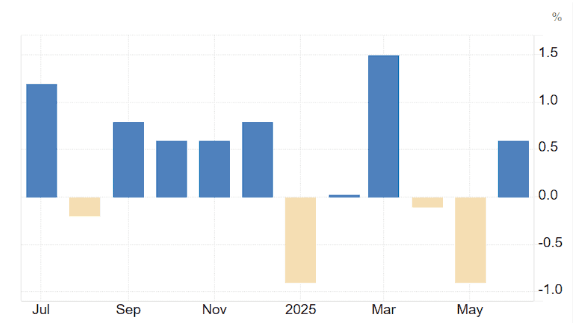


January 2026’s 2.4% YoY retail sales growth is down sharply from December’s 3.3% and the 12-month average of 3.96%. This marks a third consecutive monthly slowdown, with the pace now less than half of the May 2025 peak (5.2%). The trend since September 2025 (5.0%) has been persistently downward, reflecting both cyclical and structural headwinds.
Historical context: The last time retail sales growth was this subdued was June 2023. The current reading is also well below the post-pandemic surge, when double-digit gains were common. The deceleration is broad-based, with both durable and non-durable goods categories losing steam.