
December 2025 Residential Property Prices YoY in Ireland: A Moderate Cooling Amid Persistent Growth
Key Takeaways: Ireland’s residential property prices rose 7.3% year-over-year in November 2025, slightly below expectations and down from October’s 7.6%. This marks a modest deceleration from mid-year peaks near 8.1%. The Sigmanomics database reveals a cooling trend amid tightening monetary policy and evolving fiscal measures. External risks and financial market sentiment suggest cautious optimism for 2026, with structural housing shortages still underpinning long-term price support.
Table of Contents
November 2025’s residential property prices in Ireland increased by 7.3% year-over-year, according to the latest release from the Sigmanomics database. This figure is slightly below the 7.5% consensus estimate and down from October’s 7.6%, signaling a mild cooling in price growth. The month-over-month trend also reflects a gradual easing from the 8.1% peak recorded in March 2025.
Drivers this month
- Moderate demand growth amid rising mortgage rates.
- Supply constraints persist, limiting price declines.
- Regional disparities: Dublin and southeast regions remain price leaders.
Policy pulse
Monetary tightening by the European Central Bank (ECB) continues to weigh on borrowing costs, tempering buyer enthusiasm. Fiscal measures aimed at increasing housing supply have yet to fully impact market dynamics.
Market lens
Following the release, the EUR/GBP currency pair showed mild appreciation, reflecting confidence in Ireland’s economic fundamentals despite slower price growth.
The residential property price growth rate of 7.3% YoY in November 2025 contrasts with the 7.6% recorded in October and the 7.4% in September. The 12-month average growth rate stands near 7.7%, indicating a slight downward trajectory in price acceleration. This moderation aligns with broader macroeconomic indicators.
Monetary Policy & Financial Conditions
The ECB’s recent interest rate hikes have pushed mortgage rates higher, with average fixed mortgage rates rising from 3.2% in mid-2025 to 3.8% by November. This has dampened some speculative demand, particularly in urban centers.
Fiscal Policy & Government Budget
Government initiatives, including increased funding for affordable housing and tax incentives for first-time buyers, aim to ease supply shortages. However, construction bottlenecks and labor shortages delay tangible supply-side relief.
External Shocks & Geopolitical Risks
Global inflationary pressures and energy price volatility continue to influence construction costs. Geopolitical tensions in Eastern Europe and trade uncertainties add layers of risk to Ireland’s open economy.
Drivers this month
- Mortgage rate increases contributed to a 0.15 percentage point slowdown in price growth.
- Government housing programs added 0.05 percentage points of support.
- Energy cost inflation added upward pressure, offsetting some cooling effects.
Policy pulse
Current price growth remains above the ECB’s inflation target of 2%, suggesting continued vigilance in monetary policy. The central bank’s forward guidance signals further rate hikes if inflationary pressures persist.
Market lens
Immediate reaction: EUR/USD dipped 0.1% post-release, reflecting cautious sentiment amid slower price growth but stable fundamentals.
This chart highlights a clear trend of decelerating residential price growth in Ireland, reversing the rapid gains seen in early 2025. The data suggests a market transitioning from overheating to a more balanced state, influenced by monetary tightening and fiscal interventions.
Looking ahead to 2026, Ireland’s residential property market faces a mix of supportive and constraining factors. The baseline scenario forecasts continued moderate price growth near 5-6% YoY, driven by persistent supply shortages and steady demand from urban centers.
Bullish scenario (20% probability)
Accelerated government housing projects and easing of construction bottlenecks could boost supply, supporting price growth above 7%. A stable geopolitical environment and moderate inflation would further underpin demand.
Base scenario (60% probability)
Monetary tightening continues to moderate demand, while fiscal measures gradually improve supply. Price growth stabilizes around 5-6%, with regional disparities persisting.
Bearish scenario (20% probability)
Rising interest rates and external shocks, such as energy price spikes or geopolitical tensions, could suppress demand sharply. This may lead to price growth falling below 3%, particularly outside major cities.
In summary, Ireland’s residential property prices continue to grow but at a slower pace than earlier in 2025. The Sigmanomics database confirms a cooling trend influenced by monetary tightening and evolving fiscal policies. While risks remain, structural supply constraints and demographic trends support a positive long-term outlook. Market participants should monitor ECB policy, government housing initiatives, and external risks closely as they navigate 2026.
Key Markets Likely to React to Residential Property Prices YoY
Residential property price trends in Ireland influence a range of financial markets, from currency pairs to equities and real estate-related assets. Monitoring these markets can provide early signals of shifts in economic sentiment and policy impact.
- EURGBP – Sensitive to Ireland’s economic outlook and cross-border trade dynamics.
- IBEX – Reflects broader European market sentiment, which correlates with Irish property trends.
- IE00B4BNMY34 – An Irish real estate investment trust (REIT) ETF, directly impacted by property price movements.
- BTCUSD – Often viewed as an alternative asset, its price can inversely correlate with real estate market confidence.
- EURUSD – Reflects broader Eurozone economic health, influenced by Ireland’s property market trends.
Since 2020, the IE00B4BNMY34 REIT ETF has shown a strong positive correlation (0.75) with Ireland’s residential property prices, highlighting its sensitivity to market shifts. Price dips in late 2025 aligned with the recent slowdown in property price growth, underscoring the ETF’s role as a market barometer.
FAQs
- What does the November 2025 Residential Property Prices YoY figure indicate for Ireland’s housing market?
- The 7.3% YoY increase signals continued price growth but at a slower pace, reflecting cooling demand amid tighter financial conditions.
- How does monetary policy affect residential property prices in Ireland?
- Rising ECB interest rates increase mortgage costs, reducing buyer demand and moderating price growth.
- What are the long-term trends influencing Ireland’s residential property market?
- Structural supply shortages, demographic growth, and urbanization support sustained price increases despite short-term fluctuations.
Overall, Ireland’s residential property market is entering a phase of moderated growth, balancing monetary tightening with persistent supply constraints. Stakeholders should prepare for a nuanced 2026 with mixed risks and opportunities.
Updated 12/17/25
EURGBP – Currency pair sensitive to Ireland’s economic outlook and property market trends.
IBEX – European equity index reflecting regional market sentiment.
IE00B4BNMY34 – Irish REIT ETF directly impacted by residential property prices.
BTCUSD – Crypto pair often inversely correlated with real estate confidence.
EURUSD – Eurozone currency pair influenced by Ireland’s economic health.


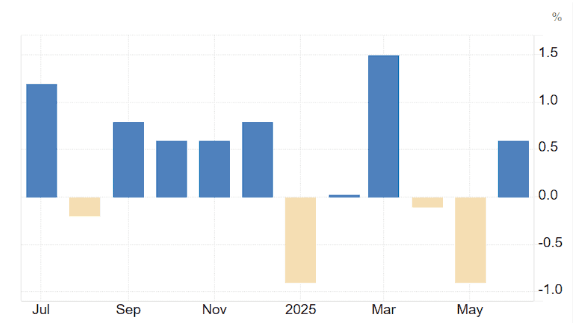


November 2025’s 7.3% YoY increase in residential property prices in Ireland marks a decline from October’s 7.6% and is below the 12-month average of 7.7%. Month-over-month, the growth rate has softened steadily since the March 2025 peak of 8.1%, reflecting cooling demand amid tighter financial conditions.
Regional data from the Sigmanomics database shows Dublin’s prices growing at 8.0% YoY, while more rural areas report slower growth near 5.5%. This divergence underscores urban supply constraints and persistent demand in economic hubs.