Forex Markets Trade Sideways as rates and growth stories remain in headlines

Summary
The Foreign exchange market is back in the headlines as rates-and-growth story, but the major currencies (EURUSD, USDJPY, AUDUSD and NZDUSD) illustrating sideways price action, awaiting a breakout. On the rates side, the Federal Reserve held its target range at 4.25%–4.50% on July 30 and kept balance‑sheet runoff intact – a stance that leaves the greenback sensitive to signs of the labor market is cooling or tariffs nudging prices higher. The Committee kept language that “inflation remains somewhat elevated,” while two voters dissented for a 25 bp cut—details, which underscore a genuine debate about when to start easing. From a indicator standpoint, U.S. CPI in July rose 0.2% m/m and 2.7% y/y (core 3.1%), a mix that preserves the market’s base case for a first 25 bp cut in September absent fresh upside surprises. As one analyst put it, “Underlying inflation remains subdued, giving policymakers room for maneuver as they respond to signs of incipient weakness in labor markets,” a succinct read that helps explain why the dollar’s post‑PPI pop quickly faded. With Jackson Hole now in sight, the market’s risk is less about the direction of travel and more about the pace—“Powell may try to temper expectations about when and how much they’ll cut,” warned one chief economist, and that nuance is what will drive tactical USD swings into month‑end.
Meanwhile, the European Central Bank left rates unchanged on July 24 while affirming commitment to the 2% target on the back of the euro area’s July flash CPI edging up to 2.6% y/y, and keeping the Governing Council on a data‑dependent path. In Tokyo, the Bank of Japan has exited emergency settings and now sits with a 0.5% policy rate. July’s Summary of Opinions tilted a shade more hawkish as members debated the timing for resuming hikes later this year. On the other hand in Sydney, the RBA cut the cash rate to 3.60% on August 12 and published a modest growth downgrade, while in Wellington, markets look for the RBNZ to shave the OCR to 3.00% on August 20, with some desks penciling one more move thereafter. Put together: narrower U.S.–RoW policy spreads are slowly re‑emerging, but uneven growth momentum and geopolitical headline risk (tariffs, Ukraine talks) are keeping forex ranges choppy rather than one‑way. For positioning, that favors expressing macro views through clearly defined levels, options around event risk, and selective carry where policy clarity is improving.
EUR/USD Analysis
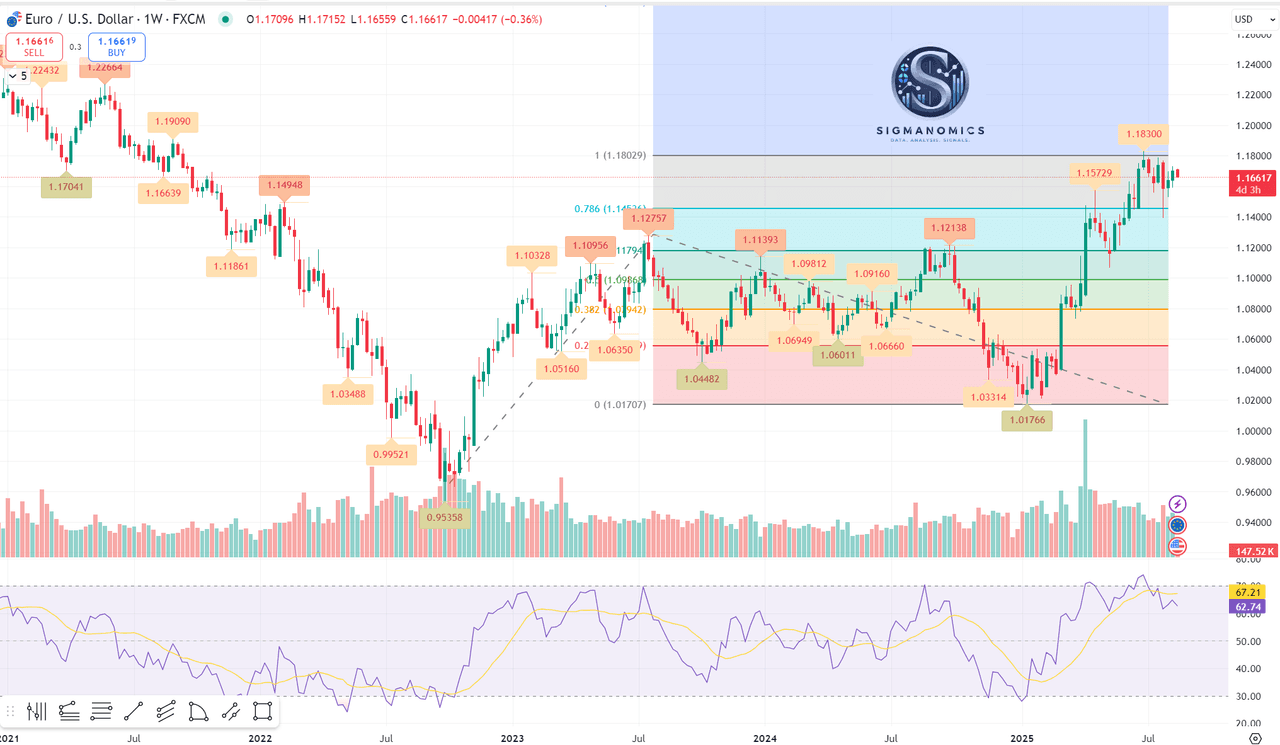
Taking a look EUR/USD as of August 18, euro versus the greenback is trading near 1.17, up from the lows of early summer but below recent peaks; the 52‑week range spans roughly 1.01–1.18. The bull case rests on three planks: (1) a Fed easing cycle that narrows policy spreads as U.S. core disinflation grinds on; (2) Europe’s inflation profile stabilizing near‑target without a growth shock; and (3) the thesis—borne out in the latest Reuters FX poll—that the euro appreciates over 12 months as U.S. exceptionalism cools. That poll, canvassing 60 strategists in early August, implied EURUSD around 1.20 on a one‑year horizon, a level consistent with a softening dollar and modest improvement in euro‑area cyclicals. Tactically, however, the pair is running into familiar supply around 1.1700–1.1750. We’d treat this as a “show‑me” zone: a weekly close above 1.1750 opens the path toward 1.18 and then 1.20 over a multi‑month window; failure keeps the door ajar for a retrace into 1.1600/1.1550 support where demand has tended to re‑emerge. The data backdrop is adequate for patience. July euro‑area HICP (flash) quickened to 2.6% y/y, an increment that neither compels the ECB to re‑tighten nor licenses a rapid cutting cycle; the Governing Council’s July 24 decision kept rates unchanged and reiterated the medium‑term 2% anchor—central banking’s way of saying “let the data lead.” On the U.S. side, July CPI’s 2.7% y/y headline and 3.1% core keep the “two‑cuts‑in‑2025” narrative alive with Jackson Hole likely to lean more signal than action. In this window, we like defining risk around levels and skewing slightly long EUR on dips that hold 1.1600, particularly into a Powell‑heavy week when rhetoric could re‑anchor expectations for a gradual path. Our technical analysts at Sigmanomics have noted that price action has stalled at the 100% Fibonacci extension on the weekly chart.
EUR/USD Weekly Chart
Source: Sigmanomics.com
Meanwhile, the European Central Bank left rates unchanged on July 24 while affirming commitment to the 2% target on the back of the euro area’s July flash CPI edging up to 2.6% y/y, and keeping the Governing Council on a data‑dependent path. In Tokyo, the Bank of Japan has exited emergency settings and now sits with a 0.5% policy rate. July’s Summary of Opinions tilted a shade more hawkish as members debated the timing for resuming hikes later this year. On the other hand in Sydney, the RBA cut the cash rate to 3.60% on August 12 and published a modest growth downgrade, while in Wellington, markets look for the RBNZ to shave the OCR to 3.00% on August 20, with some desks penciling one more move thereafter. Put together: narrower U.S.–RoW policy spreads are slowly re‑emerging, but uneven growth momentum and geopolitical headline risk (tariffs, Ukraine talks) are keeping forex ranges choppy rather than one‑way. For positioning, that favors expressing macro views through clearly defined levels, options around event risk, and selective carry where policy clarity is improving.
USDJPY — a transition market that trades policy timing and carry resilience
USDJPY sits in the high‑140s (around 147–148) after backing off early‑summer highs, with price now toggling between a still‑generous carry cushion and a BoJ that is methodically reclaiming policy space. As a snapshot: the BoJ’s policy rate is 0.5%, and the July 30–31 Summary of Opinions showed a board increasingly willing to discuss when to resume hikes; the official outlook pushed inflation projections higher, and Japan’s better‑than‑expected GDP print firmed the yen into mid‑August. That narrative has been reinforced by Washington’s messaging—U.S. Treasury Secretary Scott Bessent said the BoJ is “behind the curve” and “likely to hike,” rhetoric that markets translated into higher near‑term yen vol and more attention to upcoming policy meetings. Sell‑side houses captured the same dynamic: “The yen has been the best performing currency overnight,” MUFG wrote late last week as USDJPY slipped back toward 146 on the combination of firmer Japanese data and more hawkish BoJ chatter. Into Q4, credible public forecasts now envisage a stronger yen if the BoJ hikes once more and the Fed starts cutting. A former top Japanese FX official recently suggested 135–140 by year‑end is plausible if those conditions align, which tallies with what the forwards already imply for a modestly lower carry premium. From a trading lens, 150 remains a heavy psychological/optionality zone that tends to attract exporter offers and hedging interest; 146.00/145.20 is the near‑term demand band we’d monitor for dip buying by real money. The risk skew is asymmetric: a decisive upside break through 150 would almost certainly resurrect intervention chatter; conversely, softer U.S. data or a hawkish BoJ surprise could unleash a momentum push into the low‑140s. Given the mix—carry still pays but policy timing risk is rising—structure matters. We prefer staggered shorts expressed via put spreads or calendar structures into autumn BoJ meetings, while keeping powder dry for a potential “policy‑gap compression” moment if Powell clears the way for sequential Fed cuts. Not to overlook, price action continues to hover possible trendline support also in line with head and shoulders neckline. Should this support break and turn into resistance, bears are likely to remain in control while below 144.00.
AUDUSD and NZDUSD — policy easing vs. terms of trade
The Antipodeans are where monetary policy and external demand collide most visibly right now. Starting in Australia, the RBA delivered a 25 bp cut to 3.60% on August 12—its third this year—and openly acknowledged a softer growth path in its Statement on Monetary Policy, trimming 2025 GDP to 1.7% and conceding that the “pick‑up in GDP growth over 2025 is now more gradual than expected.” Markets quickly priced one more 25 bp cut by year‑end (median 3.35%), with the “how soon/how many” debate now resting on the labor market’s glide path and any second‑round inflation from tariffs. AUDUSD barely flinched—after an initial dip. Technically, AUDUSD remains range‑bound; resistance lies first at 0.6540/0.6625 with nearby support at 0.6450/0.6420. For Sigmanomics readers, the trade expression is straightforward: fade strength into 0.6625 unless China‑sensitive proxies (iron ore, China credit pulse) turn decisively higher; otherwise, look to accumulate on dips into 0.6450 when U.S. data re‑center the Fed‑cuts narrative. In New Zealand, the story is one of (slower) disinflation and a softer labor market giving the RBNZ room to start easing. The Reserve Bank’s Survey of Expectations placed the OCR at 3.25% pre‑August, and consensus is now clustered around a 25 bp trim to 3.00% on August 20, with some expecting “one more to go.”