S&P 500 Hits Fresh Record High Before Tech Sell-off as Rally Shows Signs of Fatigue

On August 28, the S&P 500 closed at 6,501.86, the highest level in history. The level was also 10.55% higher than on December 31, 2024 (year-to-date), and a massive 30.99% recovery from the April 8 slump.
Comparatively, the Dow only gained 7.27% YTD and recouped 21.23% from the April 8 nosedive. The tech-heavy Nasdaq Composite, on the other hand, was up 12.40% YTD and up 42.16% from April 8. In other words, the August 28 record wasn’t a broad-market celebration; it was a tech-led parade.
 Figure 1: S&P 500 vs Nasdaq (August 26 – September 2, 2025), Image Source: Sigmanomics
For context, on April 8, the market experienced its sharpest slump in years as investors reacted to sweeping new tariffs. On April 2, President Trump announced 10% tariffs on nearly all imported goods, plus higher “reciprocal tariffs” targeting countries with trade surpluses against the US. A week later, the S&P 500 had plunged 19% from its February peak, nearly breaching bear market territory.
But the market has hit at least five distinct record closing highs since then. And tech stocks were a key driver in three separate events (see the table below).
|
Date |
Closing Value |
Notable Driver |
|
August 28, 2025 |
6,501.86 |
Strong GDP, Fed optimism, tech surge |
|
August 14, 2025 |
6,389.45 |
Mega-cap tech rally |
|
July 3, 2025 |
6,279.35 |
Jobs report beat forecasts |
|
June 30, 2025 |
6,204.95 |
Trade tensions eased |
|
June 27, 2025 |
6,173.07 |
AI boom and chip sector momentum |
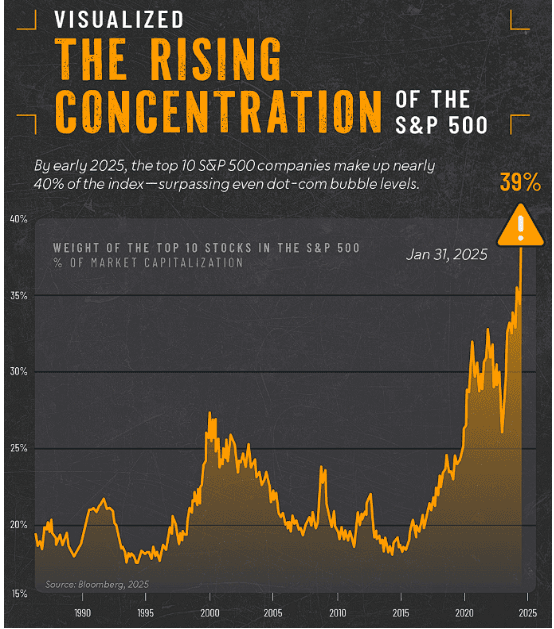
To put the current overconcentration into perspective, even at the height of the dot-com bubble, concentration levels hovered just around 30% (see the graphic below). But at nearly 40%, the top 10 companies’ share of the index now exceeds levels seen even during the dot-com bubble. Such concentration is not merely a historical anomaly, it directly affects market stability. As Ravi Kashyap’s research highlights, narrow leadership amplifies drawdown risk because index performance hinges disproportionately on a few names.
 Source: Visual Capitalist
Put simply, when only a few big names are pulling the market up, it’s risky. If they falter, the entire index suffers, just as it did in the early 2000s. Today, we’re seeing a similar setup: a few large tech stocks are driving most of the gains. So if those leaders stumble, the market could drop sharply.
However, some argue that, yes, market concentration is high and valuations are elevated, but contend that speculative excess is milder than in the pre-dot-com era (around 1999). For instance, MSCI noted in a research note that today’s top-performing tech firms have higher profitability, robust revenue growth, and more reasonable valuations compared to their dot-com counterparts. This is a stance that Cambridge Associates supports, stating that IT sector operating margins now average 23.7%, versus just 13.6% in 1998–1999. Balance sheets are also healthier, according to Cambridge Associates, which notes that companies today cover interest expenses with operating cash flow at a 9.6x ratio, compared to 5.3x in the late 1990s.
Granted, the current market bears several similarities to the dot-com era, most notably in concentration and elevated valuations. Nevertheless, the underlying fundamentals today are markedly stronger. Speculative excess appears more contained, supported by healthier balance sheets and more resilient earnings. Risk is there, but its nature is different; it is less about exuberance, more about structural exposure.
Neha Gupta
Neha Gupta is a Chartered Financial Analyst with over 18 years of experience in finance and more than 11 years as a financial writer. She’s authored for clients worldwide, including platforms like MarketWatch, TipRanks, InsiderMonkey, and Seeking Alpha. Her work is known for its technical rigor, clear communication, and compliance-awareness—evident in her success enhancing market updates.