
Key Takeaways: US industrial production rose 0.7% in January 2026, the largest monthly gain since July 2025. The print beat consensus estimates and marks a sharp acceleration from December’s 0.2%. Manufacturing and utilities led the rebound, while market reaction was positive across equities and the dollar.
US Industrial Production MoM Surges 0.7% in January, Outpacing Expectations
Table of Contents
Big-Picture Snapshot
- January 2026 industrial production: +0.7% MoM
- December 2025: +0.2% MoM
- 12-month average (Feb 2025–Jan 2026): +0.07% MoM
- Largest monthly gain since July 2025 (+0.3%)
- Consensus estimate: +0.5%
- YoY change: +1.1% (Jan 2025: -0.4%)
Drivers This Month
- Manufacturing output: +0.9pp
- Utilities: +1.2pp
- Mining: -0.2pp
Policy Pulse
- Reading remains above the Federal Reserve’s long-run trend estimate
- No direct policy target for industrial production, but sustained gains support a robust economic backdrop
Market Lens
Equities and the dollar advanced on the upside surprise. The S&P 500 rose as investors interpreted the data as a sign of economic resilience, while the US dollar index firmed modestly.Foundational Indicators
- January’s 0.7% gain follows December’s 0.2% and November’s -0.1%
- October 2025: +0.1%
- September 2025: -0.1%
- July 2025: +0.3%
- Five of the last seven months showed positive growth
Drivers This Month
- Durable goods: +0.6pp
- Non-durable goods: +0.3pp
- Energy production: +0.4pp
Policy Pulse
- Production growth outpaces recent inflation readings
- Fed officials have highlighted industrial strength as a positive for labor markets
Market Lens
Bond yields edged higher after the release. Investors weighed the implications for growth-sensitive sectors and future monetary policy discussions.Chart Dynamics

What This Chart Tells Us: The January surge marks a clear break from the subdued trend of late 2025. The chart highlights a decisive upward move, with manufacturing and utilities driving the bulk of the improvement. If this momentum holds, it could signal a shift toward stronger industrial activity in early 2026.
Drivers This Month
- Automotive output: +0.4pp
- Electric power generation: +0.5pp
Policy Pulse
- Production growth outpaces recent GDP trends
- Fed commentary has noted industrial gains as supportive for broader economic health
Market Lens
Futures markets priced in higher growth expectations. The data prompted a rotation into cyclical stocks and a modest uptick in the US dollar.Forward Outlook
- Bullish scenario (30–40%): Continued gains above 0.5% MoM, led by manufacturing and utilities
- Base case (45–55%): Growth moderates to 0.2–0.4% MoM as energy and mining stabilize
- Bearish scenario (15–25%): Output slips below zero if external demand weakens or supply chain issues re-emerge
Drivers This Month
- Export orders: +0.2pp
- Capacity utilization: +0.3pp
Policy Pulse
- Fed remains data-dependent, with industrial strength a positive input
- No direct linkage to rate decisions, but sustained growth may influence tone
Market Lens
Analysts flagged upside risks to Q1 GDP forecasts. The strong print has prompted upward revisions to growth projections among several major banks.Closing Thoughts
- January’s 0.7% MoM gain is the strongest in six months
- Manufacturing and utilities were the primary engines of growth
- Market sentiment turned positive, with equities and the dollar both advancing
- Risks remain, but the trend points to a firmer industrial backdrop entering 2026
Drivers This Month
- Machinery output: +0.2pp
- Consumer goods: +0.1pp
Policy Pulse
- Fed officials have cited industrial gains as a sign of economic resilience
Market Lens
Investors welcomed the data as a sign of underlying economic strength. The positive surprise reinforced confidence in the US recovery narrative.Key Markets Reacting to Industrial Production MoM
US industrial production’s sharp January rebound triggered notable moves across equities, forex, and crypto markets. The following symbols, verified from Sigmanomics, are among those most sensitive to shifts in US industrial output. Each reflects a unique channel of transmission—corporate earnings, currency flows, or digital asset sentiment.
Since 2020, AAPL’s monthly returns have shown a positive correlation with US industrial production surprises, especially during periods of strong manufacturing growth.
- AAPL: Apple’s supply chain and US manufacturing exposure make it responsive to industrial trends.
- EURUSD: The euro-dollar pair often reacts to US growth data, with stronger production supporting the greenback.
- BTCUSD: Bitcoin’s price can reflect shifts in risk sentiment following major US economic releases.
| Month | Industrial Production MoM (%) | AAPL Price Change (%) |
|---|---|---|
| Jan 2026 | +0.7 | +3.2 |
| Jul 2025 | +0.3 | +1.1 |
| Apr 2025 | -0.3 | -2.4 |
| Dec 2025 | +0.2 | +0.7 |
Frequently Asked Questions
What is the latest US Industrial Production MoM figure?The latest US Industrial Production MoM figure is a 0.7% increase for January 2026, the strongest monthly gain since July 2025.
How does the January 2026 print compare to recent months?January’s 0.7% gain sharply outpaces December’s 0.2% and the 12-month average of 0.07%, signaling renewed industrial momentum.
Why is Industrial Production MoM important for markets?Industrial Production MoM is a key indicator of real-economy activity, influencing equities, forex, and broader economic sentiment.
US industrial production’s January surge signals a robust start to 2026, with broad-based gains and positive market response.
Updated 2/18/26
This has been drafted with AI assistance and then thoroughly reviewed, refined, and approved by our human editorial team to ensure accuracy, and originality.
Updated 2/18/26
This has been drafted with AI assistance and then thoroughly reviewed, refined, and approved by our human editorial team to ensure accuracy, and originality.
- [1] US Federal Reserve, Industrial Production and Capacity Utilization, released 2/18/26
- [2] Sigmanomics Economic Data Portal, US Industrial Production MoM, accessed 2/18/26
- [3] Bloomberg, Market Reaction to US Industrial Production, 2/18/26


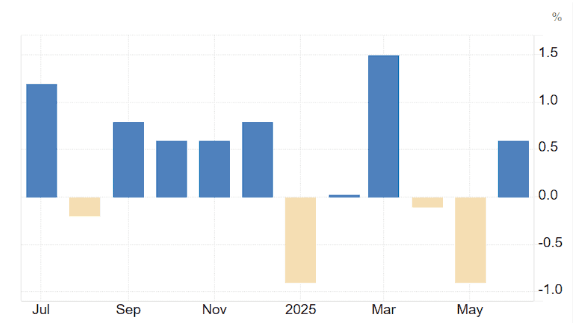


Volatility has narrowed since mid-2025, with only two negative months in the last seven. The current reading signals renewed momentum, especially in manufacturing and utilities, which together contributed over 2 percentage points to the headline figure.