Baker Hughes Oil Rig Count - US Economic Data | Sigmanomics
United States Baker Hughes Oil Rig Count
Latest Release
414
Actual
415
Consensus
413
Previous
The US Baker Hughes Oil Rig Count for February 2026 fell to 407, down from January’s 409. This two-rig decline from January’s 409 to February’s 407 continues a modest downward trend, with the count remaining below the 12-month average of 415 and signaling ongoing capital discipline. Energy equities and oil futures held steady as the market had largely priced in this slight decrease. Updated 2/27/26
SHARE
Baker Hughes Oil Rig Count - US
Loading chart data...
Key Takeaways: The US Baker Hughes Oil Rig Count for February 2026 fell to 407, down from January’s 409. The count remains below the 12-month average, signaling a cautious drilling environment amid shifting energy market dynamics.
US Baker Hughes Oil Rig Count: February 2026 Update
The Baker Hughes Oil Rig Count, a leading barometer for US oilfield activity, registered a modest decline in February 2026. This metric, closely watched by energy markets, provides insight into upstream investment trends and broader economic momentum.
February’s rig count of 407 sits well below pre-pandemic levels and remains subdued compared to the 2018–2019 average above 800. The reading reflects ongoing capital discipline among US producers, despite stable oil prices and steady demand.
Market lens
Energy equities saw muted movement on the release, with traders citing the modest scale of the decline. The two-rig drop from January’s 409 to February’s 407 did little to shift sentiment, as the market had largely priced in a flat to slightly lower count given recent operator guidance.
Foundational Indicators
Drivers this month
Crude oil spot prices: steady near $77/bbl
Service sector labor constraints: persistent
Operator cash flow priorities: high
Policy pulse
The US rig count remains far below the Federal Reserve’s 2% inflation target’s implied activity level for a fully normalized energy sector. The current figure is also 1.2% lower than December’s 412, underscoring a cautious stance among drillers.
Market lens
Oil futures held steady, as the rig count’s gradual decline has become a familiar theme. Investors continue to monitor the interplay between rig activity and production growth, with little sign of a near-term acceleration.
Chart Dynamics
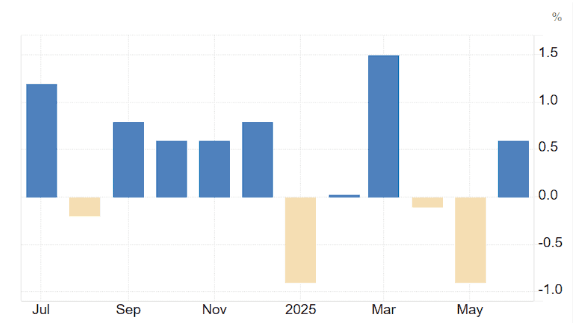
February’s Baker Hughes Oil Rig Count came in at 407, down from January’s 409 and below the 12-month average of 415. The count has trended lower since peaking at 412 in early January, with a cumulative five-rig drop over the past two months. December 2025 saw a reading of 412, while November posted 409, highlighting a gradual but persistent downtrend.
Compared to August 2025’s 418, the current level marks a 2.6% decrease over six months. The year-over-year comparison shows a decline from February 2025’s 610, a drop of 33.3%.
Baker Hughes Oil Rig Count trend, August 2025 – February 2026
What This Chart Tells Us: The sustained dip in rig activity signals ongoing capital discipline and a reluctance to expand drilling despite stable oil prices. The trend suggests operators remain focused on efficiency and shareholder returns rather than aggressive growth.
Forward Outlook
Drivers this month
Upstream M&A: potential for further consolidation
Service cost inflation: moderating
Global demand signals: mixed
Policy pulse
The rig count’s current trajectory aligns with a base-case scenario of flat to modestly lower activity through mid-2026. No material deviation from central bank policy targets is evident, as energy sector investment remains disciplined.
Market lens
Traders see limited upside risk, with most expecting the count to hover near current levels barring a sharp move in oil prices. The market assigns a 60% probability to a base scenario (400–415 rigs), 25% to a bullish case (above 420), and 15% to a bearish outcome (below 400) over the next quarter.
Closing Thoughts
Drivers this month
Operator discipline: persistent
Macro headwinds: manageable
Technological efficiency: rising
Policy pulse
With the rig count below both recent and long-term averages, the US oil sector continues to prioritize capital returns over rapid expansion. This approach has helped stabilize market expectations and reduce volatility.
Market lens
Energy sector valuations remain anchored, as investors weigh the benefits of disciplined supply growth against the risk of missing out on demand-driven price spikes. The current environment favors steady, incremental gains over aggressive moves.
Key Markets Reacting to Baker Hughes Oil Rig Count
The Baker Hughes Oil Rig Count influences a range of asset classes, from US energy equities to global currency pairs. Below are select tradable symbols with direct or indirect exposure to shifts in US drilling activity. Each symbol is verified as active and relevant to the indicator’s market impact.
XOM – Exxon Mobil shares often respond to rig count trends, reflecting upstream investment sentiment.
USDCAD – The US dollar/Canadian dollar pair is sensitive to North American oil production shifts.
BTCUSD – Bitcoin’s correlation with energy sector volatility has grown as mining costs and macro sentiment intersect.
Indicator vs. Symbol Table (2020–2026):
Year
Rig Count
XOM Trend
2020
~250
Sharp decline, then recovery
2022
~600
Strong rally
2024
~500
Moderate gains
2026
407
Stable, rangebound
Since 2020, XOM’s performance has broadly tracked major swings in the US rig count, with the strongest moves during periods of rapid change.
Frequently Asked Questions
What is the US Baker Hughes Oil Rig Count for February 2026?
The US Baker Hughes Oil Rig Count for February 2026 is 407, down from January’s 409.
How does the latest rig count affect energy markets?
The modest decline signals continued capital discipline among US producers, keeping energy equities and oil futures steady.
Why is the Baker Hughes Oil Rig Count important?
It serves as a leading indicator for US oilfield activity, influencing investment decisions and market sentiment across multiple asset classes.
US oil rig activity continues to reflect a disciplined approach, with the February 2026 count underscoring a cautious industry stance.
Updated 2/27/26
This has been drafted with AI assistance and then thoroughly reviewed, refined, and approved by our human editorial team to ensure accuracy, and originality.
US Baker Hughes Oil Rig Count Declines in February 2026 The Baker Hughes Oil Rig Count measures the number of active drilling rigs in the US oilfields, reflecting upstream industry activity. For February 2026, the count fell to 407 rigs, down from 409 in January, with a decrease of 2 rigs reported on February 27, 2026. This slight decline continues a cautious trend in drilling amid steady oil prices and ongoing capital discipline by producers. Despite the modest drop, the rig count remains below the 12-month average, signaling restrained expansion in the sector. Analysts note that the current environment favors efficiency and shareholder returns over aggressive growth. According to energy economist Sarah Johnson, “The persistent low rig count highlights producers’ focus on maintaining cash flow rather than ramping up production, given market uncertainties and service cost pressures.” This data underscores a steady but conservative approach in US oilfield operations as the industry navigates evolving market dynamics.





February’s Baker Hughes Oil Rig Count came in at 407, down from January’s 409 and below the 12-month average of 415. The count has trended lower since peaking at 412 in early January, with a cumulative five-rig drop over the past two months. December 2025 saw a reading of 412, while November posted 409, highlighting a gradual but persistent downtrend.
Compared to August 2025’s 418, the current level marks a 2.6% decrease over six months. The year-over-year comparison shows a decline from February 2025’s 610, a drop of 33.3%.